

From Strategy to Action: Controlling How AI Systems Describe Your Brand
Part 2: From Understanding to Implementation
In Part 1, we explored how AI systems use Wikipedia as a foundational credibility source. We mapped the pipeline, explained the weighting mechanisms, and showed why Wikipedia has become central to how LLMs and knowledge graphs understand your brand.
Now it’s time to act.
This article is the operational counterpart: how to build, optimize, and maintain a Wikipedia presence that actively shapes AI-generated answers about your organization.
The Three Part Wikipedia GEO Strategy

If you want to control how AI systems talk about your brand, you need a three part approach:
1. Establish Authoritative Wikipedia Presence
First, your Wikipedia page needs to exist, and it needs to be comprehensive, accurate, and well cited.
For organizations (especially in fintech, real estate, and healthcare), this means:
- Clear, neutral description of what you do
- Founding story and key milestones
- Leadership and team structure
- Products/services overview
- Regulatory status (especially critical for fintech)
- Notable achievements and industry recognition
- All claims backed by citations to reputable sources
For executives, this means:
- Career trajectory with key accomplishments
- Education and professional credentials
- Publications and thought leadership
- Industry recognition and awards
- All claims supported by third party coverage
The key here is comprehensiveness paired with neutrality. Your Wikipedia page shouldn’t read like a marketing copy. It should read like an encyclopedia entry, factual, balanced, and well sourced.
Wikipedia’s credibility comes from citations and those citations need to come from authoritative external sources.
2. Build the Citation Network (Earned Media Strategy)
This is where Digital PR strategy directly supports Wikipedia optimization.
When we place a client in Forbes discussing their fintech innovation, that article becomes a Wikipedia citable source. When an executive speaks at a major conference and gets covered by an industry publication, that coverage can support their Wikipedia narrative. When a healthcare organization earns recognition from a medical association, that becomes citable validation.
The bridge between ORM and Wikipedia optimization is earned media. Every piece of authoritative press coverage you secure becomes potential citation material for your Wikipedia presence.
This is why the strongest Wikipedia pages are built by organizations that have already invested in thought leadership and media relations. The PR ecosystem creates the sourcing that Wikipedia requires.
3. Optimize for LLM Discoverability and Citation
Once your Wikipedia page is solid, the next step is ensuring that LLMs can easily extract and cite it.
This involves:
- Clear section structure – LLMs parse Wikipedia’s hierarchical structure. Well organized sections (Overview, History, Products, Leadership, etc.) are easier for models to understand and cite.
- Explicit claims with citations – Don’t just state facts. State them in ways that are clearly supported by citations. When an LLM sees “[Citation needed]” tags, it learns not to rely on that information.
- Linked entities – Wikipedia’s linking structure helps LLMs understand relationships. If your company page links to your executives’ Wikipedia pages, and those link back, the model understands the organizational structure.
- Updated information – LLMs are trained on specific versions of Wikipedia. If your page is outdated, the LLM’s understanding of your organization is outdated.
- Consistent entity references – If your company is mentioned as “Company X,” “Company,” and “Organization X” across different pages, LLMs have to work to understand they’re the same entity. Consistency makes LLM processing easier.
The Real World Impact: How Wikipedia Shapes AI Answers
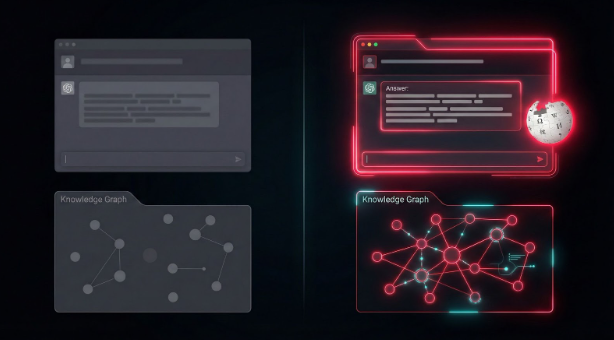
Here’s a concrete example:
Scenario: A fintech platform wants to understand how ChatGPT describes it.
Current state: The company has a website, LinkedIn presence, and some press coverage, but no Wikipedia page.
When asked “What does [Company] do?” ChatGPT generates an answer based on available training data. Without Wikipedia, the model relies on:
- Fragmented press coverage (some from reputable sources, some not)
- The company website (which the model treats as biased)
- LinkedIn descriptions (also self promotional)
- Secondary mentions in other articles (variable quality)
- Knowledge graphs that lack a verified entity reference point
Result: ChatGPT gives a vague, uncertain answer. It hedges claims. It might miss key regulatory information. It might mischaracterize the business model. The knowledge graph shows incomplete information because it has no authoritative entity anchor.
Now add a Wikipedia page:
A comprehensive, well cited Wikipedia entry is added. It clearly states the company’s regulatory status, founding, key products, leadership team, and market position, all supported by citations from reputable publications.
When ChatGPT is asked the same question again, it now has:
- A primary authoritative source (Wikipedia)
- Clear, neutral information
- Verified citations supporting key claims
- Structured entity information that feeds into knowledge graphs
- A credibility signal that appears across multiple sources
Result: ChatGPT gives a confident, accurate answer. It cites the Wikipedia page. When users follow that citation, they see a credible, professional representation of the company. The knowledge graph shows complete, verified information. Trust increases across all touchpoints.
That difference, vague vs. confident, hedged vs. authoritative, is the real impact of Wikipedia in the LLM era.
And it happens invisibly, in the background, shaping how potential customers, investors, and partners understand your organization.
Five Actions to Build Your Wikipedia GEO Foundation

1. Audit Your Current Wikipedia Presence
Search your company name on Google, Gemini, and ChatGPT. Notice what shows up. If there’s a Wikipedia page, read it carefully, what’s accurate? What’s outdated? What’s missing?
If there’s no Wikipedia page, check whether you meet notability standards for one (significant media coverage, industry recognition, documented history).
2. Map Your Citation Gaps
Every major claim on your Wikipedia page needs to be supported by a citation from a reputable, independent source. Identify gaps: What achievements, products, or milestones aren’t yet cited?
These gaps are your PR targets. They represent earned media you need to secure.
3. Build Your Earned Media Pipeline
Prioritize media placements in publications that are authoritative enough to serve as Wikipedia citations. Think industry publications, major business outlets, academic journals (for healthcare), regulatory announcements.
Every piece of media you earn becomes a potential Wikipedia citation, and therefore a stronger foundation for how AI systems understand you.
4. Monitor How AI Systems Describe You
Set a quarterly checkpoint: Ask ChatGPT, Gemini, and Claude the same questions about your company. Track whether the answers improve, become more consistent, and cite your Wikipedia page.
This is your leading indicator for whether your Wikipedia GEO strategy is working.
5. Establish Ongoing Wikipedia Maintenance
Assign someone (or partner with an agency) to monitor your Wikipedia page monthly. Flag edits, update outdated information, add new citations as media accumulates, and respond to any bad faith edits immediately.
Wikipedia isn’t a set it and forget it asset. It requires ongoing stewardship.
The Bigger Picture: Wikipedia Is Your GEO Foundation
In the age of AI, where LLMs are becoming the primary research tool for decision makers, your Wikipedia presence is foundational to how your brand is understood at scale.
It’s not just about appearing in search results anymore. It’s about controlling how AI systems process, synthesize, and communicate your value to the world.
Traditional SEO optimized for human searchers. GEO optimizes for AI systems. And the foundation of GEO is Wikipedia, the source that AI systems trust most, even as they pull from multiple data streams.
Brands that recognize this and invest in their Wikipedia presence now will have a compounding advantage: better Wikipedia presence → better knowledge graph data → better AI answers → better discovery → more trust → better business outcomes.
At Buzz Dealer, we combine Digital PR, ORM, and content strategy to build and optimize Wikipedia presence as the foundation of a comprehensive GEO strategy. We help organizations secure the earned media that creates Wikipedia citations. We ensure your Wikipedia page is accurate, comprehensive, and positioned for LLM discoverability.
Because in 2025, your Wikipedia page isn’t optional. It’s where your reputation lives.
Ready to audit your Wikipedia GEO foundation? Book a free strategy call and let’s map how AI systems currently understand your brand, and how we can strengthen that presence.