Personal Online Reputation Management
Control The Information That People See When Searching For YOU Online
Get in Touch
What Is Personal Online Reputation Management?
Personal Online Reputation Management (Personal ORM) is the practice of shaping what people, and AI engines, find, conclude, and repeat when they search an individual's name. For founders, executives, and public figures, that first impression increasingly forms before any conversation takes place, and it shapes hiring, investment, partnership, and board decisions. For the AI engines specifically, see AI reputation management.
Get The Online Recognition That You Deserve
Google yourself for a second. What do you see?
Are you happy with the results? If not, you probably need personal reputation management.
With Personal ORM, you'll be able to:
- Have information about you correctly presented online
- Build authority and trust in your industry
- Differentiate yourself from similar people
- Remove negative and counterproductive information
- Build your online presence, entity and persona
- Get the attention that you deserve
How We Work Our Magic
Nothing Is Impossible. It May Take Hard Work, but We'll Get It Done Right.
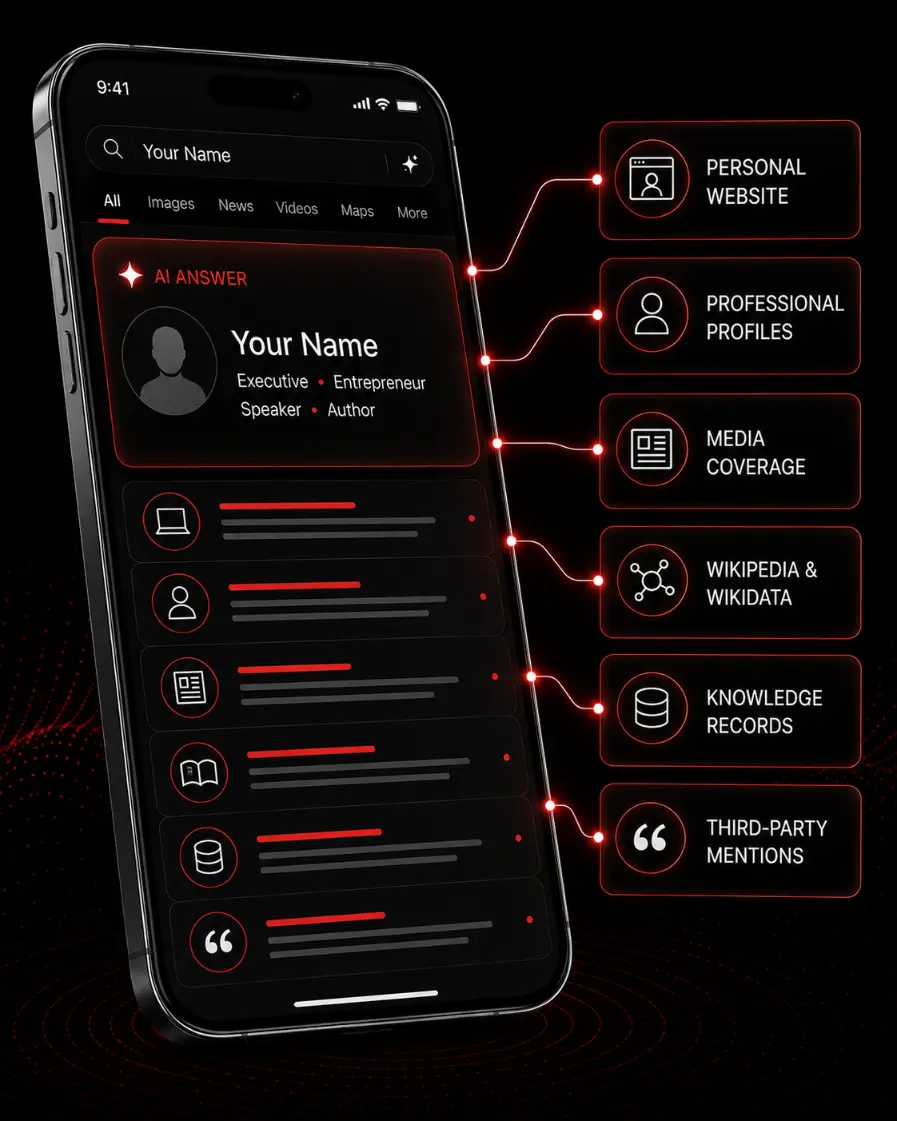
Creating Your Digital Entity
Your digital entity needs a source - a personal website, a page on your company's website, etc. We'll start by creating and/or optimizing this source, and connect it to all other relevant sources.
Getting You Media Coverage
It's not only what's written about you that matters. Where it's written is also very important. That's why we take care of both, getting you favorable mentions on authoritative and credible websites.
Aligning Your Digital Assets
We'll audit your current social profiles, and enrich them with additional assets that can contribute to your online presence, to the extent of Wikimedia assets, knowledge panels and beyond.
Making Sure Everything Is in Place
Creating positive results is good, but it's not enough. The name of the game is bringing the top results about you up, while suppressing the negative or non-relevant ones, and constantly monitoring these results.
Who We Help: ORM for Private People and Public Figures

Founders & CEOs
For founders and CEOs, your name is inseparable from your company's value. Investors search you before a term sheet, journalists before a story, and acquirers before an offer, and what they find shapes the number on the table. We engineer a founder reputation that holds up to diligence: accurate, authoritative search results, a verified knowledge panel, third-party media that corroborates your track record, and a clean entity graph that AI tools draw on. The result is a personal brand that builds confidence in capital-raising conversations and transfers credibility directly to the company you are building. Our guide to CEO reputation management explains how to audit and strengthen an executive's presence across search and AI.

Executives (C-suite & board members)
Executives are evaluated long before an interview or a board vote. Search committees, recruiters, regulators, and reporters all form opinions based on what they find online, and gaps or outdated results quietly cost opportunities. We establish a current, controlled executive presence: an accurate professional record, knowledge-panel and entity recognition, leadership content that demonstrates expertise, and media coverage that reinforces your standing in your sector. For executives in transition or facing a public moment, we manage the narrative proactively, so your reputation reflects your actual record rather than the loudest result.

Public figures & speakers
For public figures, speakers, and thought leaders, visibility is the product, but unmanaged visibility is a liability. We build a coherent public presence that compounds: consistent positioning across search and social, a verified knowledge panel, media coverage that elevates authority, and content that keeps you discoverable for the topics you want to own. As AI engines increasingly answer "who is..." questions directly, we make sure those answers describe you accurately and favorably, so every booking, partnership, and press request starts from credibility.

High-net-worth individuals
For high-net-worth individuals and families, the goal is rarely more visibility. It is the right visibility, on your terms. We provide discreet, family-office-grade reputation management: removing or displacing unwanted exposure, correcting inaccurate records, and maintaining a controlled, low-profile presence that protects privacy and security while preserving the credibility you need for business and philanthropic relationships. Every engagement is handled with strict confidentiality and a defensive posture, designed to keep you out of conversations you do not want to be in.

Pre-IPO & fundraising founders
When you are raising or approaching an IPO, your personal reputation becomes part of the diligence file. Investors, bankers, and regulators scrutinise the founder as closely as the financials, and inconsistencies, thin records, or unaddressed negative coverage create friction at the worst possible moment. We prepare your reputation for that scrutiny: a consistent growth narrative across every source, regulator-aware framing, corroborating third-party media, and a verified entity profile that AI-assisted diligence tools read correctly. The aim is simple: remove reputation as a reason for hesitation.
Individuals in crisis
When a single result, article, or association threatens your reputation, speed and strategy matter more than anything. If something damaging about you is ranking or spreading today, or someone with your name is in the news, Reputation ER is the fastest way to reach us. We respond to wrongful associations, damaging articles, and post-incident fallout with a structured plan: rapid assessment, suppression and displacement of harmful results, accurate counter-narrative content, and corrected records across the sources that feed both Google and the AI engines. Our goal is to restore an accurate, fair picture of who you are and make it durable, so the recovery holds long after the immediate crisis has passed.
Personal Reputation in the AI Era
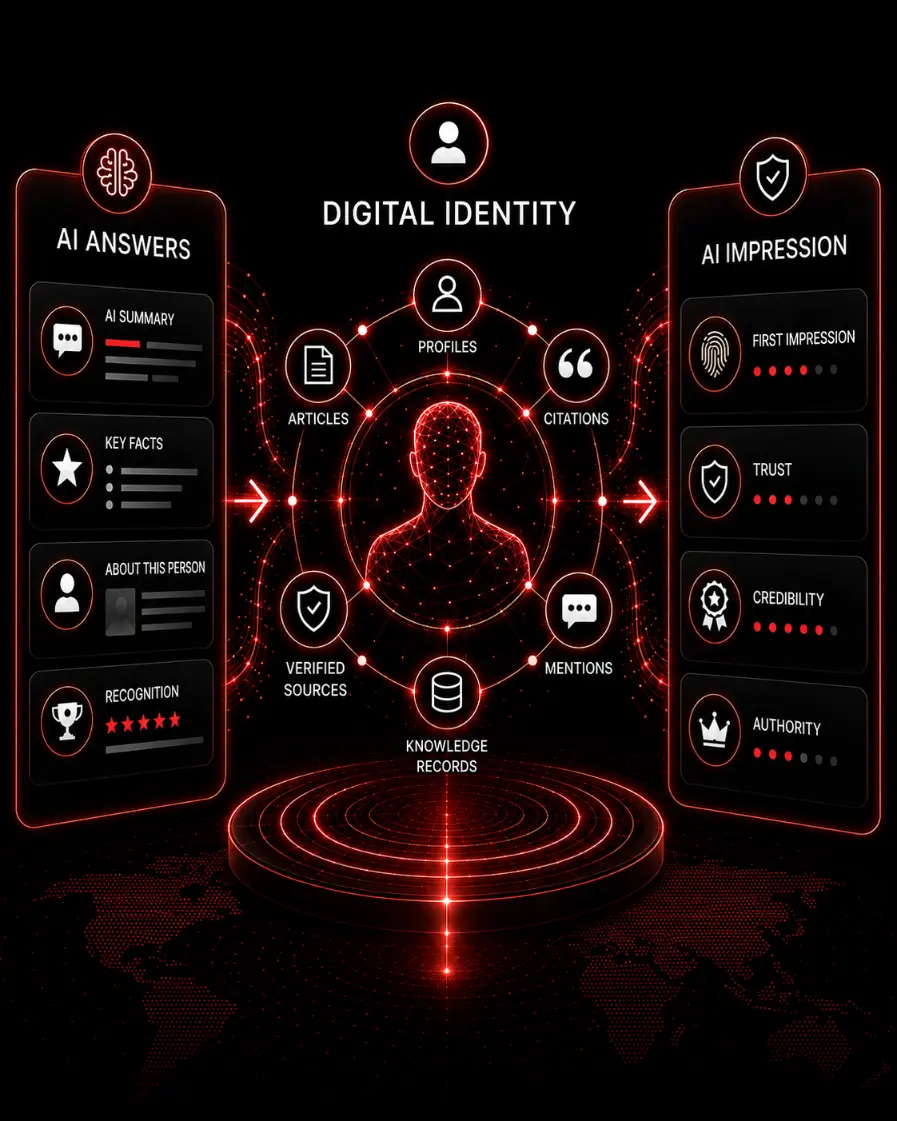
Search used to mean a list of links. Increasingly, it means an answer. When someone asks ChatGPT, Gemini, Perplexity, or Google's AI Overview about a person, the engine does not return ten results. It synthesises one confident summary from across the web. That changes personal reputation management in three fundamental ways.
First, the AI answer is the new first impression. A partner running diligence, a journalist on deadline, or a recruiter screening candidates will often read what an AI says about you before they ever open Google. If that summary is wrong, thin, or shaped by a single bad source, the damage is done before you know the conversation happened.
Second, AI engines reward structure and consistency, not volume. They lean on entity records, verified profiles, knowledge panels, and corroborating third-party sources, and a single contradictory or outdated source can poison the synthesis. A clean, consistent entity graph is now foundational, not optional.
Third, the work is continuous. AI outputs shift as models update and as the web changes beneath them, so reputation is no longer a one-time cleanup. It is a position to hold.
Our AI-era methodology reflects this: entity verification and structured-data alignment, sameAs graph engineering across authoritative profiles, third-party signal consistency, Wikidata and knowledge-panel establishment where appropriate, and continuous monitoring of what the major AI engines actually say about you, so the answer stays accurate as the landscape moves.
Our Process

Analyzing the current status
We start with a complete picture of your current footprint: what ranks for your name across Google and the major AI engines, what is accurate, what is outdated, what is missing, and what is working against you. We map the entity records, profiles, and third-party sources that shape how both search and AI describe you, and benchmark against where you need to be. You receive a clear baseline and a prioritised list of risks and opportunities.

Developing the right strategy
From the baseline we build a plan matched to your goals, your situation, and your timeline, whether that is diligence-readiness for a raise, repositioning for a new role, or quiet protection of a private profile. The strategy defines target outcomes, the assets we will build, the sources we will engage, the messaging that ties them together, and the metrics we will hold ourselves to.

Setting the foundations for your online entity
We establish the controlled assets that anchor your reputation: an accurate, authoritative core presence, verified profiles, structured data and entity records, and, where notability supports it, knowledge-panel and Wikidata groundwork. These are the trustworthy first-party signals Google and AI engines rely on, and they form the stable base everything else reinforces.
Spreading content and information about you online
With foundations in place, we expand your authority through credible third-party coverage and content: media placements, expert commentary, and thought-leadership that corroborate your record and displace weaker or negative results. Because the sources are independent and authoritative, they strengthen how both search and AI engines assess and describe you.

Optimization & Monitoring
Finally, we optimise for durability and keep watch. We refine search results and structured data, track rankings and AI-engine outputs for your name, and respond as the web and the models shift. Reputation is not static, so neither is the work. You stay protected, accurate, and discoverable over time.
Wikipedia, Wikidata, & Knowledge Panels
For many founders and executives, the most powerful reputation assets are the ones Google and AI engines treat as authoritative facts: a Wikipedia page, a Wikidata record, and a verified Google knowledge panel. Together they form your entity, the structured identity that search and AI draw on when describing who you are.
We approach these carefully and honestly. Wikipedia is governed by strict notability and neutrality standards, so we begin with an eligibility assessment rather than a promise. Where the case for notability is strong, we develop a well-sourced, community-compliant page. Where it is not yet, we build the lower-friction alternatives that still deliver entity recognition: a structured Wikidata record, knowledge-panel establishment, and corrections to inaccurate Knowledge Graph information. We also strengthen the third-party coverage that notability ultimately depends on.
The payoff is significant. A verified entity gives AI engines a trusted, structured source to cite, which makes their answers about you more accurate and harder to distort. It is one of the highest-leverage components of modern Personal ORM.
Explore Our Wikipedia Services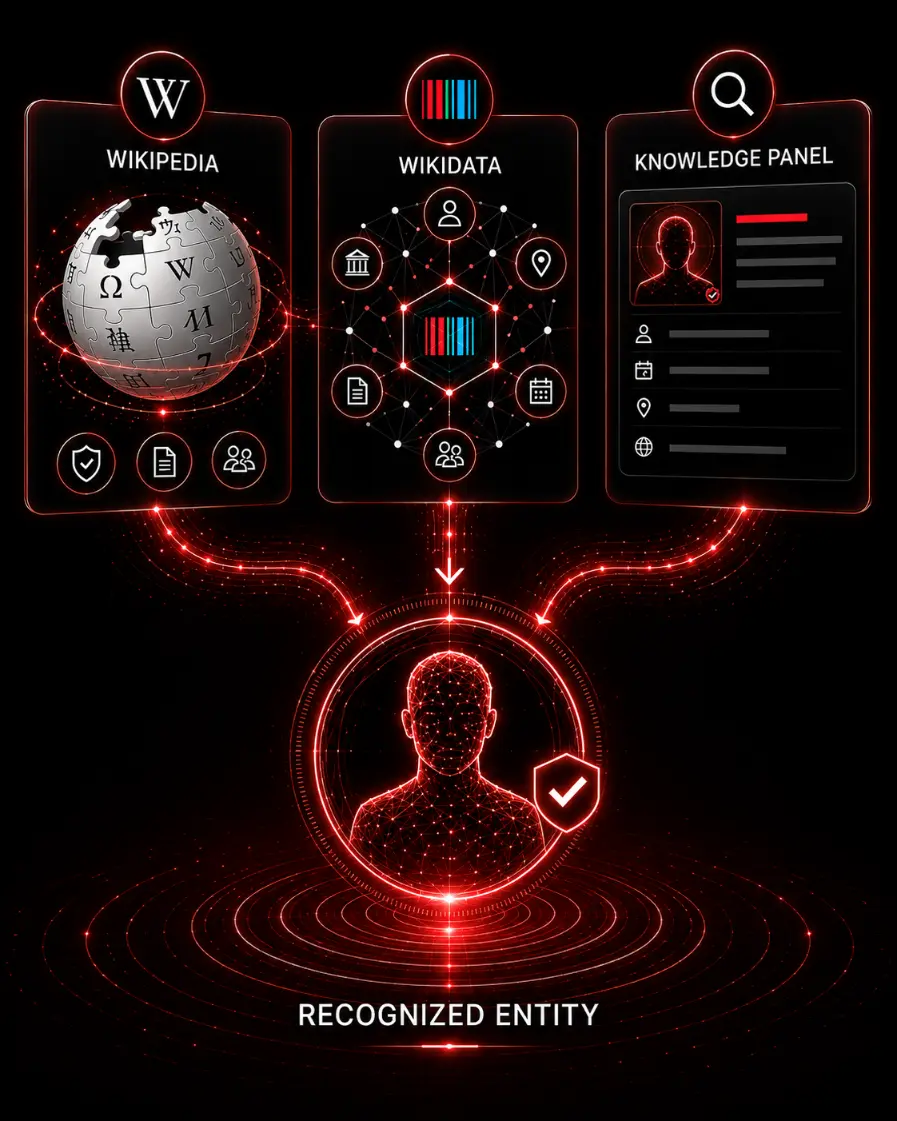
Personal ORM In Action
Pre-IPO founder: diligence-ready reputation
A fintech founder preparing to raise came to us with thin, inconsistent search results, a real risk under investor scrutiny. Over five months, we established a verified knowledge panel, aligned entity records across the major profiles, and secured three tier-1 media features. By the time diligence began, searches and AI summaries presented a consistent, credible founder narrative, and reputation was no longer raised as a concern in investor calls.
Executive transition: establishing a new leader
When a new chief economist joined a private-sector investment firm, their public presence did not yet match the seniority of the role, and outdated, irrelevant information crowded the results. Over a year-long engagement we built an accurate professional record, leadership content, and corroborating coverage. Within the first quarter, the prior irrelevant information was almost completely gone, replaced by an accurate picture of their expertise.
Crisis rebuild: restoring an accurate picture
An individual facing a wrongful association in the press needed harmful results addressed quickly. We deployed a structured response: rapid assessment, displacement of damaging results, accurate counter-narrative content, and corrected records. In less than a month, the negative first-page results were largely replaced, and the overall sentiment of the front-page results turned positive.
Why Buzz Dealer
Buzz Dealer has managed complex personal reputation cases for over 15 years, for clients including Forbes-listed billionaires, Fortune 500 executives, politicians, and high-profile public figures across industries and jurisdictions.
These are rarely simple cases: longstanding negative results that resisted earlier attempts, Wikipedia inaccuracies that require careful navigation of editorial policy, and content programs orchestrated across dozens of publications at once. We pair that media reach with deep technical capability in the structured-data and entity work that AI-era reputation now depends on. Most agencies do PR or do SEO.
Personal ORM done properly needs both, plus the entity-graph engineering that makes AI engines describe you accurately, applied to the one search result you can least afford to get wrong: your own name. And because so much is at stake for the people we work with, discretion is built into everything we do.
Why Personal Reputation Matters Now
70% of employers research candidates through social media and online search.
~69% of all Google clicks go to the top three results.
1B+ people now see Google's AI-generated answers.
Page 1 captures almost every click; the second page is rarely seen.



FAQs About Our Personal Reputation Management Services
Why does personal reputation matter more for founders than ever before?
Most founders assume their online reputation is fine because they have not seen anything obviously damaging. The more pressing issue is control. When someone searches your name or asks an AI engine about you, what they find is assembled from whatever happens to exist online, not from the narrative you would choose to present. Personal ORM is about closing that gap: ensuring that the information, tone, and story someone encounters when they research you is as close as possible to what you would want them to see.
The stakes for founders are higher than for most professionals. Early-stage investors know that founder quality strongly predicts whether a startup survives, so due diligence now routinely includes both a review of your search presence and AI research conducted directly in tools like ChatGPT, Gemini, Claude, Perplexity, Copilot, and others. Old, negative, or inconsistent information no longer gets naturally buried over time the way it once did in search results, because generative engines synthesize everything available rather than ranking by recency.
If the story someone finds is thin, contradictory, or dominated by outdated information, it introduces friction into funding conversations, hiring, and partnerships before you ever get the chance to address it directly. A strong personal reputation means that when someone researches you through search engines or AI engines, they encounter a coherent, credible narrative that supports doing business with you.
How do generative AI engines evaluate personal reputation and credibility?
Generative AI engines look at four main buckets: your professional history, documented achievements, independent validation, and consistency of your personal story across the web.
Professional history includes roles, companies, sectors, and tenure. Documented achievements include exits, funding rounds, patents, published work, and significant projects. Independent validation comes from media features, conference talks, podcasts, board or advisory roles, and mentions on high-authority sites.
Consistency is crucial. If your personal bios, interview quotes, thought leadership content, and databases like Crunchbase or news archives tell different versions of who you are and what you stand for, generative engines become less confident about how to describe you. When your professional profiles, published articles, speaking appearances, and third-party mentions all reinforce the same clear narrative, AI engines like ChatGPT and Gemini are more likely to present you as a recognized expert rather than just another name in their training data.
What should professionals do to build a personal brand for AI visibility?
Professionals including executives, senior managers, investors, public figures, and independent experts should deliberately document their story, build independent validation, and keep their public footprint consistent so generative AI engines have strong signals to work with.
This starts with clear, detailed personal bios on your own site that explain your background, track record, and areas of expertise in plain language. Next comes building independent validation through guest articles, interviews, podcast appearances, speaking at industry events, and being quoted in relevant publications - this kind of third-party coverage is what signals credibility to generative engines, not just self-published content.
You should also keep your main professional profiles, company pages, and thought leadership content aligned around the same narrative. When ChatGPT, Gemini, Claude, Perplexity, Grok and others scan the web about you, they should find the same core story reinforced across multiple independent sources. Over time, that is what turns you into a recognizable and trustworthy entity in the eyes of both people and generative AI.
If negative information exists about me online, can it be removed from search results and AI?
The first step is always identifying where the negative information originates, because neither search engines nor generative AI engines generate negative descriptions on their own. They surface and synthesize what already exists in reviews, forum posts, articles, complaints, and public records. Addressing the source is what changes the output.
Once the source is identified, the approach depends on what it is. Fake, defamatory, or policy-violating content on review platforms or forums can be reported for removal, and when removed, both search engines and AI engines gradually lose that signal. For inaccurate content, contacting the publisher with documented corrections is the most direct route. For genuine complaints or reviews reflecting real experiences, resolving the underlying issue and encouraging the person to update their feedback addresses the problem at the source.
Where removal or correction is not possible, the strategy shifts to building a stronger body of accurate, authoritative content that rebalances the narrative. This means creating and placing content across multiple sources simultaneously: published articles, media features, interview appearances, updated professional profiles, third-party mentions on high-authority sites, and structured data that reinforces the facts. When search algorithms and generative engines have access to a richer, more consistent set of signals about who you are today, the negative material loses its relative weight and your actual narrative begins to take its place. Our guide to how to remove unwanted results from Google walks through each route in order, and what to do when removal is off the table.
What specific outcomes should professional personal reputation management deliver?
Professional personal reputation management should deliver a clear, consistent, and well-documented digital presence that accurately represents who you are across search engines, generative AI engines, and professional profiles.
The foundation comes first: a precise, detailed personal bio aligned across your own website and third-party profiles, consistent factual information that helps generative engines like ChatGPT, Gemini, Claude, Perplexity, Copilot and others identify you as a recognized entity, and structured data that reinforces your identity signals in search.
From there, the work builds outward: new pieces of information added through thought leadership content and interviews that expand your documented footprint, a clear positioning as an authority in your specific field, and third-party coverage that corroborates your professional narrative rather than contradicting or ignoring it.
Over time, the outcome is a person who is a properly identified entity in search - one where all key sources tell the same coherent story, where generative engines have enough reliable material to summarize you accurately, and where the public record reflects your actual expertise and current role rather than outdated or incomplete information.
How does your personal reputation affect your company's reputation and valuation?
For early stage companies, founder reputation and company reputation are almost the same thing. Strong founder credibility can lift perceived valuation and reduce friction in fundraising, hiring and partnerships. Weak or uncertain founder signals do the opposite.
Investors are not only backing a product or a market, they are backing the people responsible for execution. When AI engines and search results paint a clear picture of successful past work, relevant expertise, and serious external validation, investors view the company as a safer bet.
As companies grow, personal reputation continues to matter for strategic partnerships, senior hires and exit discussions. Buyers and partners still look at who is in charge. The stronger the leadership story, the easier it becomes to close high quality deals on better terms. Before deciding on a route, it helps to know how much reputation repair costs and how long it takes. If the damage is already visible when people search your name, see our online reputation repair services.
Should I hire a professional personal brand manager, especially if raising capital?
Professional personal brand management, also known as personal reputation management, is most valuable when fundraising, entering new markets, pursuing board roles, or when consistent thought leadership is not something you have the time or infrastructure to maintain. Investors increasingly rely on online search, AI summaries, and direct generative engine research during early diligence, making founder visibility and narrative coherence commercially significant long before any formal meeting takes place.
Fragmented media presence, inconsistent profiles across platforms, and a thin third-party footprint are among the most common reasons founders receive weak or vague descriptions when investors research them through search engines or AI engines. These are not problems that resolve themselves over time, and in a fundraising context, the cost of that friction is real.
Buzz Dealer's personal reputation programs provide positioning strategy, access to media placements, crisis preparation, and structured profile optimization across the sources that search algorithms and generative engines rely on most. For most founders and executives, professional guidance accelerates credibility, ensures narrative consistency, and removes the diligence friction that can quietly slow down conversations that matter.
How does professional personal reputation management specifically improve your AI search positioning?
Professional personal reputation management improves AI search positioning by ensuring generative engines have accurate, consistent, and well-sourced information about you across every surface they scan.
This means aligning personal bios, professional profiles, thought leadership content, and third-party mentions around a single coherent narrative so generative engines like ChatGPT, Gemini, Claude, Copilot, Grok and others recognize you as a clearly identified, trustworthy entity. When the same factual story appears across multiple independent sources, generative engines become more confident in how they describe you and more likely to surface your name in relevant answers.
Buzz Dealer personal reputation programs map how generative engines currently describe a person, identify where information is missing, inconsistent, or outdated, and then close those gaps through structured data, profile optimization, thought leadership content, and third-party coverage that corroborates the personal narrative.
Why hire Buzz Dealer for personal reputation management?
Buzz Dealer has been managing complex personal reputation cases for over 15 years. That experience spans Forbes-listed billionaires, Fortune 500 executives, politicians, and high-profile public figures across industries and jurisdictions, people whose cases require far more than profile optimization and review management.
The situations we are called in for are rarely straightforward. They include longstanding negative search results that have resisted previous attempts to address them, Wikipedia inaccuracies that require careful navigation of editorial policies, large-scale content programs that need to be orchestrated across dozens of publications simultaneously, and reputation challenges where the right solution is not obvious and requires creative thinking built on genuine experience. We have handled all of these, repeatedly, across some of the most scrutinized individuals in business and public life.
Our process covers every surface that matters: how you appear in search results, what generative engines like ChatGPT, Gemini, and others say about you, your media footprint, structured data, social profiles, and third-party references. We build, optimize, and monitor all of it as a connected system rather than isolated tactics. And because the people we work with often have a great deal at stake, discretion is built into everything we do, from how we communicate to how we structure and execute every program.
See what people and AI find about you
Enter your name and a little identifying context to generate an automated Personal Visibility & Reputation Audit across AI answers, search results, news, sentiment, and your wider digital footprint.