

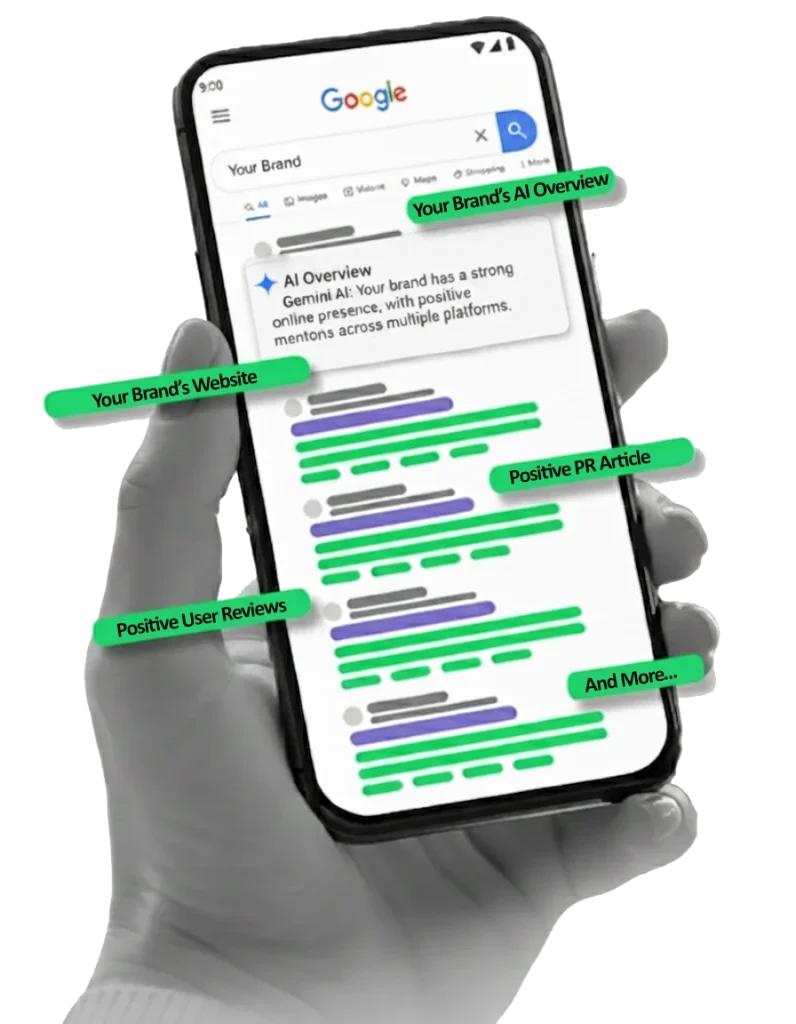
Personal Online Reputation Management

Control The Information That People See When Searching For YOU Online

Get The Online Recognition That You Deserve

Google yourself for a second. What do you see?

Are you happy with the results? If not, you probably need personal reputation management.

With personal ORM you’ll be able to:

  • Have information about you correctly presented online
  • Build authority and trust in your industry
  • Differentiate yourself from similar people
  • Remove negative and counterproductive information
  • Build your online presence, entity and persona
  • Get the attention that you deserve

How We Work Our Magic

There’s No Such Thing as Impossible. It May Take Hard Work, But We’ll Get It Done Right!

Creating Your Digital Entity

Your digital entity needs a source – a personal website, a page on your company’s website, etc. We’ll start by creating and/or optimizing this source, and connect it to all other relevant sources.

Getting You Media Coverage

It’s not only what’s written about you that matters. Where it’s written is also very important. That’s why we take care of both, getting you favorable mentions in authorized and credited websites.

Aligning Your Digital Assets

We’ll audit your current social profiles, and enrich them with additional assets that can contribute to your online presence, to the extent of Wikimedia assets, knowledge panels and beyond.

Making Sure Everything Is in Place

Creating positive results is good, but it’s not enough. The name of the game is bringing the top results about you up, while suppressing the negative or non-relevant ones, and constantly monitoring these results.

Our Process

Analyzing the current status

Developing the right strategy

Setting the foundations for your online entity

Spreading content and information about you online

Using SEO techniques to optimize your online visibility

Our Process

Analyzing the current status

Developing the right strategy

Setting the foundations for your online entity

Spreading content and information about you online

Using SEO techniques to optimize your online visibility

Building Your Online Entity

Personal Management

Social Networks

Positive Media

Structured Data

WEB 2.0 Profiles

Content Development

Did You Know

14

YEARS IN BUSINESS

300

ORM PROJECTS

6000

ARTICLES PUBLISHED

More than 1 billion names are searched on Google everyday

62% have used a search engine to look up their own name

31% searched online information about colleagues

94% only look at the first page of google's search results

FAQs About Our Personal Reputation Management Services

Most founders assume their online reputation is fine because they have not seen anything obviously damaging. The more pressing issue is control. When someone searches your name or asks an AI engine about you, what they find is assembled from whatever happens to exist online, not from the narrative you would choose to present. Personal ORM is about closing that gap: ensuring that the information, tone, and story someone encounters when they research you is as close as possible to what you would want them to see.

The stakes for founders are higher than for most professionals. Early-stage investors know that founder quality strongly predicts whether a startup survives, so due diligence now routinely includes both a review of your search presence and AI research conducted directly in tools like ChatGPT, Gemini, Claude, Perplexity, Copilot, and others. Old, negative, or inconsistent information no longer gets naturally buried over time the way it once did in search results, because generative engines synthesize everything available rather than ranking by recency.

If the story someone finds is thin, contradictory, or dominated by outdated information, it introduces friction into funding conversations, hiring, and partnerships before you ever get the chance to address it directly. A strong personal reputation means that when someone researches you through search engines or AI engines, they encounter a coherent, credible narrative that supports doing business with you.

Generative AI engines look at four main buckets: your professional history, documented achievements, independent validation, and consistency of your personal story across the web.

Professional history includes roles, companies, sectors, and tenure. Documented achievements include exits, funding rounds, patents, published work, and significant projects. Independent validation comes from media features, conference talks, podcasts, board or advisory roles, and mentions on high-authority sites.

Consistency is crucial. If your personal bios, interview quotes, thought leadership content, and databases like Crunchbase or news archives tell different versions of who you are and what you stand for, generative engines become less confident about how to describe you. When your professional profiles, published articles, speaking appearances, and third-party mentions all reinforce the same clear narrative, AI engines like ChatGPT and Gemini are more likely to present you as a recognized expert rather than just another name in their training data.

Professionals including executives, senior managers, investors, public figures, and independent experts should deliberately document their story, build independent validation, and keep their public footprint consistent so generative AI engines have strong signals to work with.

This starts with clear, detailed personal bios on your own site that explain your background, track record, and areas of expertise in plain language. Next comes building independent validation through guest articles, interviews, podcast appearances, speaking at industry events, and being quoted in relevant publications – this kind of third-party coverage is what signals credibility to generative engines, not just self-published content.

You should also keep your main professional profiles, company pages, and thought leadership content aligned around the same narrative. When ChatGPT, Gemini, Claude, Perplexity, Grok and others scan the web about you, they should find the same core story reinforced across multiple independent sources. Over time, that is what turns you into a recognizable and trustworthy entity in the eyes of both people and generative AI.

The first step is always identifying where the negative information originates, because neither search engines nor generative AI engines generate negative descriptions on their own. They surface and synthesize what already exists in reviews, forum posts, articles, complaints, and public records. Addressing the source is what changes the output.

Once the source is identified, the approach depends on what it is. Fake, defamatory, or policy-violating content on review platforms or forums can be reported for removal, and when removed, both search engines and AI engines gradually lose that signal. For inaccurate content, contacting the publisher with documented corrections is the most direct route. For genuine complaints or reviews reflecting real experiences, resolving the underlying issue and encouraging the person to update their feedback addresses the problem at the source.

Where removal or correction is not possible, the strategy shifts to building a stronger body of accurate, authoritative content that rebalances the narrative. This means creating and placing content across multiple sources simultaneously: published articles, media features, interview appearances, updated professional profiles, third-party mentions on high-authority sites, and structured data that reinforces the facts. When search algorithms and generative engines have access to a richer, more consistent set of signals about who you are today, the negative material loses its relative weight and your actual narrative begins to take its place.

Professional personal reputation management should deliver a clear, consistent, and well-documented digital presence that accurately represents who you are across search engines, generative AI engines, and professional profiles.

The foundation comes first: a precise, detailed personal bio aligned across your own website and third-party profiles, consistent factual information that helps generative engines like ChatGPT, Gemini, Claude, Perplexity, Copilot and others identify you as a recognized entity, and structured data that reinforces your identity signals in search.

From there, the work builds outward: new pieces of information added through thought leadership content and interviews that expand your documented footprint, a clear positioning as an authority in your specific field, and third-party coverage that corroborates your professional narrative rather than contradicting or ignoring it.

Over time, the outcome is a person who is a properly identified entity in search – one where all key sources tell the same coherent story, where generative engines have enough reliable material to summarize you accurately, and where the public record reflects your actual expertise and current role rather than outdated or incomplete information.

For early stage companies, founder reputation and company reputation are almost the same thing. Strong founder credibility can lift perceived valuation and reduce friction in fundraising, hiring and partnerships. Weak or uncertain founder signals do the opposite.

Investors are not only backing a product or a market, they are backing the people responsible for execution. When AI engines and search results paint a clear picture of successful past work, relevant expertise, and serious external validation, investors view the company as a safer bet.

As companies grow, personal reputation continues to matter for strategic partnerships, senior hires and exit discussions. Buyers and partners still look at who is in charge. The stronger the leadership story, the easier it becomes to close high quality deals on better terms.

Professional personal brand management, also known as personal reputation management, is most valuable when fundraising, entering new markets, pursuing board roles, or when consistent thought leadership is not something you have the time or infrastructure to maintain. Investors increasingly rely on online search, AI summaries, and direct generative engine research during early diligence, making founder visibility and narrative coherence commercially significant long before any formal meeting takes place.

Fragmented media presence, inconsistent profiles across platforms, and a thin third-party footprint are among the most common reasons founders receive weak or vague descriptions when investors research them through search engines or AI engines. These are not problems that resolve themselves over time, and in a fundraising context, the cost of that friction is real.

Buzz Dealer’s personal reputation programs provide positioning strategy, access to media placements, crisis preparation, and structured profile optimization across the sources that search algorithms and generative engines rely on most. For most founders and executives, professional guidance accelerates credibility, ensures narrative consistency, and removes the diligence friction that can quietly slow down conversations that matter.
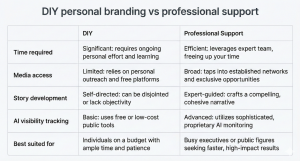
 

## Professional personal reputation management improves AI search positioning by ensuring generative engines have accurate, consistent, and well-sourced information about you across every surface they scan.

This means aligning personal bios, professional profiles, thought leadership content, and third-party mentions around a single coherent narrative so generative engines like ChatGPT, Gemini, Claude, Copilot, Grok and others recognize you as a clearly identified, trustworthy entity. When the same factual story appears across multiple independent sources, generative engines become more confident in how they describe you and more likely to surface your name in relevant answers.

Buzz Dealer personal reputation programs map how generative engines currently describe a person, identify where information is missing, inconsistent, or outdated, and then close those gaps through structured data, profile optimization, thought leadership content, and third-party coverage that corroborates the personal narrative.

Buzz Dealer has been managing complex personal reputation cases for over 15 years. That experience spans Forbes-listed billionaires, Fortune 500 executives, politicians, and high-profile public figures across industries and jurisdictions, people whose cases require far more than profile optimization and review management.

The situations we are called in for are rarely straightforward. They include longstanding negative search results that have resisted previous attempts to address them, Wikipedia inaccuracies that require careful navigation of editorial policies, large-scale content programs that need to be orchestrated across dozens of publications simultaneously, and reputation challenges where the right solution is not obvious and requires creative thinking built on genuine experience. We have handled all of these, repeatedly, across some of the most scrutinized individuals in business and public life.

Our process covers every surface that matters: how you appear in search results, what generative engines like ChatGPT, Gemini, and others say about you, your media footprint, structured data, social profiles, and third-party references. We build, optimize, and monitor all of it as a connected system rather than isolated tactics. And because the people we work with often have a great deal at stake, discretion is built into everything we do, from how we communicate to how we structure and execute every program.

Ready To Upscale Your Business?

Send Us a Message Now!