

I consent to receive email communications and agree to the Privacy Policy.
Get the 5-star impression that your brand deserves!
The online financial services industry has been one of our main expertise for many years. We currently maintain the online reputation of over 100 brands on an ongoing basis, ranging from CFD trading, forex trading, crypto trading, crypto exchanges, multi-assets brokers, PSPs, local banks and more.
We provide ORM services for financial brands in over 15 languages, and our vast experience in this industry allows us to successfully handle its unique challenges. Our ORM service will allow you to:
Advanced and Innovative Approaches to Elevate Financial Brands
Our unique reach to hundreds of high authority financial and news websites, top industry websites and leading news aggregators, will amplify your message.
Get more users to organically find your mobile trading app on the relevant app stores (when searching for related terms), install it and use it more frequently.
Let us professionally and transparently manage your campaigns on Google, Facebook and additional platforms as an agency, and lower your CPLs and CPAs.
Whether you have an in-house SEO team or not, you can use our vast experience in SEO for financial brands, to fully outsource your SEO or to enhance its link-building activities.
Fintech ORM is different because trust is the product itself. When someone considers using a payment platform, trading app, or digital wallet, their primary question is not whether the service is good but whether it is safe to put their money there. General ORM manages how people feel about a brand; fintech ORM manages whether people feel safe enough to act.
General ORM focuses on review management, sentiment monitoring, and suppressing negative or irrelevant information across search and social channels. Fintech ORM covers all of that, but the nature of the negative information is categorically different: scam and fraud allegations, reports of withdrawal problems, data security concerns, and fund safety questions spread rapidly through fintech-specific communities, forums, and app store reviews, and they carry direct financial consequences for users who read them.
App store ratings matter more in fintech than almost any other sector because the app is often the entire product. A pattern of one-star reviews citing “can’t access funds” or “suspicious activity” will stop user acquisition immediately regardless of what the company website says. Generative engines like ChatGPT, Gemini, Claude, Perplexity, Copilot and others synthesize these signals the same way humans do – and a fintech brand associated with those terms faces a much steeper recovery path than a retail brand dealing with slow delivery complaints.
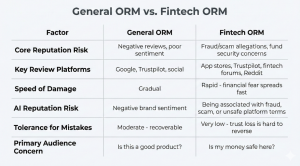
Fintech brands face a specific AI reputation risk: generative engines synthesize information from multiple sources simultaneously, and in fintech the most damaging source categories – scam allegations, fraud warnings, fund withdrawal complaints, and data security reports – carry far more weight with readers than a bad restaurant review ever would.
When users post warnings on Reddit, fintech forums, or app stores about being unable to access funds, suspicious platform behavior, or unresolved disputes, generative engines like ChatGPT, Gemini, Claude, Perplexity, Copilot and others pick up those patterns across multiple independent sources. Because these reports appear on platforms that AI treats as credible community signals, they can heavily influence how a fintech brand is described in AI-generated summaries – even if the individual cases were later resolved or the complaints came from a small minority of users.
The compounding problem is timing. A wave of negative app store reviews or forum warnings can shape how generative engines describe a fintech brand for months, because the negative content accumulates faster than positive signals can replace it. Fintech ORM addresses this directly by monitoring the specific platforms and communities where these signals originate, managing review responses and resolution patterns that generative engines recognize, and ensuring that accurate, positive information is consistently available across the sources those engines draw from.
Ensuring accurate generative engine descriptions of your fintech brand requires consistent, trustworthy signals across the platforms and sources those engines draw from – your own website, app store listings, review platforms, and fintech-specific communities.**
Start with your own digital presence: your website should clearly describe what your platform does, who it serves, and how it protects users, written in plain language that generative engines like ChatGPT, Gemini, Claude, Perplexity, Copilot and others can easily extract and repeat. Structured data helps those engines identify your brand correctly and connect it to the right category and context.
From there, the focus shifts to the external signals that carry the most weight in fintech: app store ratings and review content, responses to user complaints on public platforms, and how your brand appears in fintech forums and communities. When generative engines see a consistent pattern of professional responses, resolved issues, and positive user feedback across these sources, they are more likely to describe your brand as trustworthy and reliable rather than pulling from isolated negative signals.
When someone researches a fintech brand, whether a potential user, partner, or business contact, they typically look in two places: search results and generative engines. What they find in both is shaped less by your own website than by the pattern of reviews, forum discussions, app store ratings, and community mentions that have accumulated about you.
Fintech ORM manages those signals proactively across the platforms where fintech users, from CFD and forex traders to crypto exchange users and PSP customers, actually talk and share experiences: app stores, Trustpilot, Reddit, fintech-specific forums, and social platforms. This means review responses are professional and consistent, genuine complaints are resolved and followed up, and positive user experiences are actively encouraged across the right channels.
When generative engines like ChatGPT, Gemini, Claude, Perplexity, Copilot and others synthesize what is known about a fintech brand, they draw heavily from these community and review signals. A brand with a strong, consistent pattern of resolved complaints and positive feedback across multiple platforms is described very differently from one where the dominant signals are unresolved withdrawal complaints or fraud warnings. Fintech ORM ensures that when someone asks about your platform, the answer reflects your actual track record rather than isolated negative events.
Effective fintech ORM programs combine review and sentiment management, website and entity optimization, content development, digital PR in fintech-specific publications, ASO for trading apps, and continuous generative engine monitoring to ensure accurate brand representation across all channels where users and partners research you.**
Review and sentiment management is the foundation: monitoring what users say across Trustpilot, app stores, fintech forums, and social platforms, responding professionally, resolving genuine complaints, and actively encouraging satisfied customers to share their experience. For mobile trading apps specifically, app store ratings require their own dedicated management since the app is often the first and primary interaction a user has with the brand.
On top of review management, fintech ORM includes keeping your website accurate and well-structured so generative engines like ChatGPT, Gemini, Claude, Perplexity, Copilot and others can correctly identify and describe your brand. Content about your platform, team, and track record needs to be visible in credible fintech publications and news sources so that independent third-party signals reinforce what your own site says. SEO ensures favorable and accurate results appear prominently in search, while negative or non-relevant information is suppressed over time.
A professional fintech ORM agency should commit to transparent, measurable progress across review sentiment, search visibility, app store performance, and how generative engines describe your brand. The right agency should also be able to show you where you stand before the engagement begins, not weeks into it.
## With Buzz Dealer, the groundwork happens at the presale stage. By the time a program launches, we already have a clear picture of which platforms carry the most critical signals, what search results and generative engines are currently saying about your brand, and where the highest-impact interventions are. That means work starts immediately and results are typically visible from the first month, not after a lengthy onboarding and mapping phase.
## As the program progresses, measurable outcomes include improved average ratings across key review platforms, a growing volume of verified positive feedback, more consistent and professional review response management, stronger search visibility for accurate and credible content, and a more accurate and favorable brand description across generative engines. These outcomes compound over time as each layer of the program reinforces the next, but the trajectory should be visible and trackable from the start.
Choose a fintech ORM agency based on their direct experience managing reputation for financial brands specifically, not only general ORM providers who apply the same approach across every industry regardless of how different the challenges are.**
The right agency understands that fintech users have a fundamentally different concern than customers of most other businesses: the safety of their money. That means the agency should have experience managing fraud and scam-related allegations, withdrawal complaint patterns, app store rating issues, and the fintech-specific communities and forums where trust is built.
In fintech ORM evaluations, Buzz Dealer finds that the most common failure among general ORM providers is treating fintech brands the same as retail or hospitality clients, without accounting for how quickly financial trust collapses and how differently fintech users respond to unresolved complaints.
Fintech brands operating internationally face reputation challenges that multiply with each new market: user reviews, forum discussions, and community warnings appear in local languages on platforms that vary by region, and a problem that surfaces in one market can spread to others before it is even detected.
Buzz Dealer provides fintech ORM in over 15 languages, covering CFD trading, forex, crypto exchanges, PSPs, and multi-asset brokers across multiple markets. This means review monitoring, response management, content development, and sentiment tracking are handled by people who understand both the language and the specific fintech community norms in each market, ensuring that the brand signals generative engines pick up are consistent, accurate, and positive regardless of where a user is searching from.
Buzz Dealer brings specific, long-standing expertise in financial brand reputation management, currently maintaining the online reputation of over 100 fintech brands on an ongoing basis, spanning CFD trading, forex, crypto exchanges, multi-asset brokers, PSPs, and local banks across more than 15 languages.
We start where your reputation problems are most visible: app store ratings, review platforms, fintech forums, search results, and the third-party coverage that shapes how users and business partners perceive your brand. From there we build a coordinated program that addresses review management, profile and content accuracy, and media presence across every channel your users and counterparties actually use. As your program matures, we also track and optimize how generative engines describe your brand, ensuring that AI-driven research reflects the same accurate, positive picture as everything else.
Because we also run GEO, SEO, digital PR, and ASO for mobile trading apps under one roof, your fintech reputation is managed as a coordinated program rather than a collection of disconnected activities. Review signals, search visibility, app store performance, and generative engine descriptions are all worked on together, compounding over time into a brand that is trusted, accurately represented, and well-positioned in every channel where your users and partners look for you.