The digital landscape has fundamentally shifted. What started in 2025 as cautious experimentation with AI, now in 2026, has become the dominant discovery mechanism for how people find information. We’re no longer in an era of searching for links; we’re entering an era where users simply ask AI for answers, and the AI synthesizes the response before they ever see a search result page.
For years at Buzz Dealer, we’ve been quietly architecting our internal systems for this exact transition; we’ve been studying how LLMs process information, observing how they weigh sources, and most critically, reverse-engineering how they decide what brands to recommend. Today, following our recent announcement unveiling our dedicated GEO services, we’re ready to share the GEO-First Framework, a complete reimagining of how brands build genuine authority in an AI-driven world.
This isn’t just another service line; it’s a fundamental rebuild of how we work internally, unifying SEO, Online Reputation Management (ORM), and Digital PR into something entirely different for the AI era. These three disciplines, which have historically operated in separate silos, are now one unified strategy, and that shift changes everything.
Here’s what we’ve learned: the blue link no longer drives value; Synthesized Authority is the new currency.
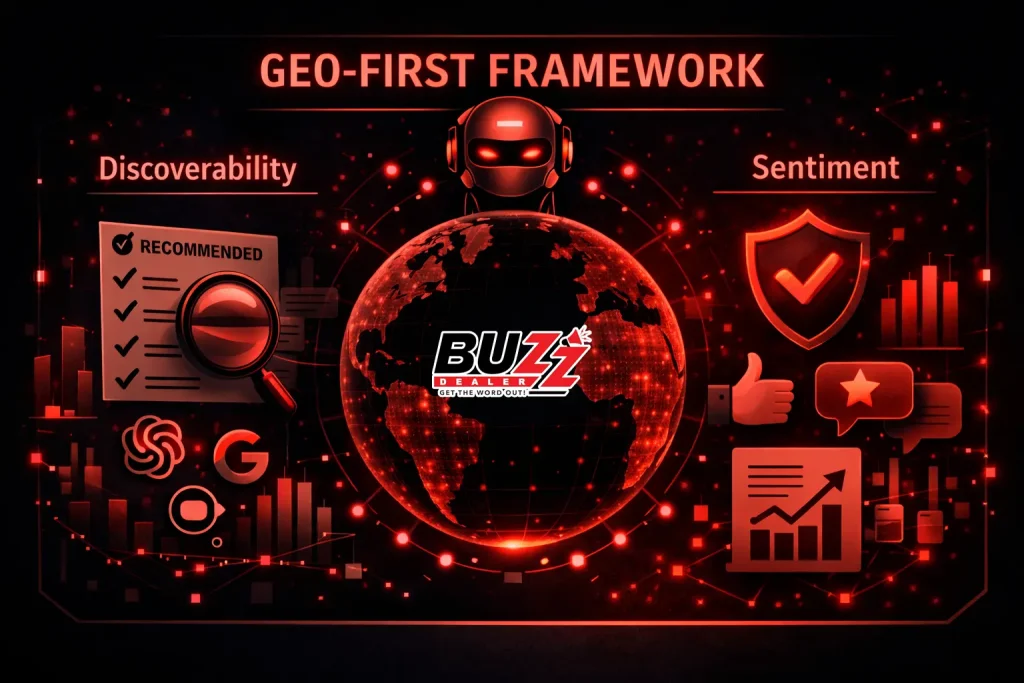
The Two Pillars of GEO: Discoverability vs. Sentiment
Generative engine optimization (GEO) operates on two fronts, and success requires winning on both; being discovered by an AI system is only half the battle, while the other half involves being recommended by that AI with genuine trust and credibility.
This distinction is more critical than it sounds because visibility without credibility doesn’t drive conversions; it creates friction, a friction that loses you the sale before the conversation even starts. A CEO might discover your company through an AI search, but if that same AI hedges the recommendation with doubts or caveats, you’ve already lost the opportunity. Conversely, credibility without visibility means nothing if your ideal customer never finds you in the first place, so both pillars are essential; you need them working together.

1. GEO Discoverability (The Evolution of SEO)
Traditional SEO was about keywords and rankings; GEO-Discoverability is about Narrative Inclusion. When a user asks an AI assistant to “find the best fintech platform for corporate scaling,” the AI synthesizes an answer from hundreds of sources, not returning a ranked list but constructing a narrative.
Our framework ensures your brand is part of that synthesized narration. We optimize your digital footprint so that Large Language Models like ChatGPT, Gemini, and Claude don’t just see your website; they understand your unique value propositions well enough to explain them to users with authority and accuracy. In the old web, you won by ranking number one; in the AI web, you win by becoming the definitive answer.
2. GEO Sentiment (The Evolution of ORM)
In the AI era, appearing in a recommendation isn’t enough; it must be a “clean” recommendation. Imagine an AI recommending your brand but adding: “…however, several recent reports suggest technical instabilities in their latest update.” A recommendation with a warning plants doubt, and often does more damage than no recommendation at all.
This is why our approach involves looking at Online Reputation Management (ORM) through a GEO lens. We monitor “Sentiment Drift” in AI models, tracking how these systems describe your brand over time and ensuring that the conversational output remains positive, authoritative, and free of hallucinations or outdated negativity. When both pillars work together, your brand doesn’t just appear in recommendations; it becomes the recommendation.
Integrating Digital PR: The ‘AI Visibility’ Metric
The way we measure media success has fundamentally changed. Historically, Digital PR success was measured by reach or authority; within the GEO-First Framework, we’ve introduced a new metric:AI Visibility.
A press placement in a top-tier publication no longer exists primarily to drive traffic to your website; it exists to feed authoritative signals into the AI systems that will synthesize answers about your brand. Every article, every mention, every link is now a data point that influences how LLMs understand and trust you.
When we build SEO campaigns and Digital PR roadmaps, our systems now evaluate every source based on its influence on LLMs; every article we publish serves a dual purpose: it drives traditional organic traffic and brand awareness (the 2024 metric), while feeding the AI trust signals that position you as the authority in your space (the 2026 metric).
A press placement in a high-authority publication tells the entire AI ecosystem something simple but powerful: This brand is credible; other credible entities have written about them; cite them.
Content Engineered for Machine Understanding
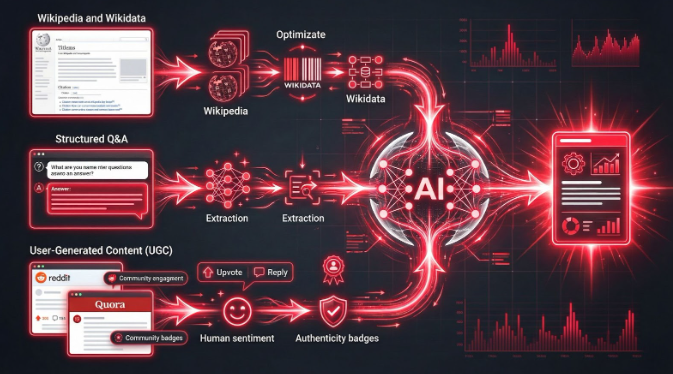
To win at GEO, content must be structured in a way that AI systems actually value. Our framework moves beyond traditional blog posts and into three high-influence content types that LLMs are trained to recognize, cite, and prioritize:
- The Wikipedia & Wikidata Ecosystem: Wikipedia remains a foundational “source of truth” for nearly every major AI engine. When ChatGPT, Gemini, or Claude needs to understand who you are and what you’ve accomplished, Wikipedia is typically the first source it consults. We’ve built our framework around Wikipedia as the anchor for your brand’s identity because a well-maintained Wikipedia presence tells AI systems something powerful: This entity is real, verified, and notable enough for the world’s most trusted reference platform. That signal shapes everything else an LLM learns about your brand.
- Structured Q&A and Listicles: AI models are fundamentally designed to provide direct, synthesized answers. When LLMs generate responses, they need sources that provide clear, structured information they can cite and build upon. By restructuring your brand data into Q&A formats and authoritative listicles, you’re making it dramatically easier for AI to recognize your brand as the definitive solution to user questions. Instead of forcing the AI to synthesize your value from blog prose, you’re handing it pre-structured information it’s trained to prioritize and reference.
- User-Generated Content (UGC) Mastery: AI engines don’t trust corporate messaging alone; they cross-reference what real humans are saying about you on Reddit, Quora, and niche industry forums to verify sentiment and validate claims. When an LLM recommends your brand, it’s silently checking: Are humans actually saying good things about this company? If your technical optimization says you’re the best, but the organic conversation says otherwise, LLMs notice the conflict. Our framework includes strategic focus on these platforms to ensure the organic conversation around your brand reinforces (rather than contradicts) your authority signals.
The Buzz Dealer Shift: Why It Matters for Our Clients
Our CEO, Uri Samet, captured the core insight perfectly during the framework’s development: “We’ve stopped looking at SEO, PR, and ORM as separate silos. In the AI era, they are the same thing. If the AI doesn’t see you, you don’t exist. If the AI doesn’t trust you, you don’t sell.”
That perspective isn’t just intellectual clarity; it fundamentally changes what winning looks like for your brand. When clients move to a GEO-First approach, three critical shifts happen:
- Your Brand Speaks with One Voice: Instead of scattered signals across Wikipedia, press coverage, social media, and scattered content (all potentially saying slightly different things), your brand now maintains complete consistency across every AI system that might research you. No more contradictions between your Wikipedia page and what’s trending on Reddit; no more confusion between how you describe yourself and how major publications describe you; everything reinforces the same core narrative, and that coherence is what AI systems recognize as authoritative.
- You Build Immunity to Reputation Attacks: We don’t just react when something negative emerges about your brand; instead, we proactively build what we call the “Source-Truth”: authoritative, verified information locked into the AI ecosystem before competitors or critics can distort the narrative. Your brand’s story is established, cited, and reinforced before anyone attempts to attack it; this fundamentally shifts power dynamics in your favor.
- You Get Real Visibility into AI Perception: You see exactly how often your brand gets recommended by AI systems when relevant; but here’s where it gets strategic: you also understand how those recommendations are framed. Are they positive? Is the context accurate? Are warning flags appearing? All of this is measurable, and that’s what separates strategic advantage from vanity metrics. When you can track sentiment, context, and accuracy in AI answers, you’re looking at a leading indicator of future revenue; because AI recommendations directly influence purchasing decisions.
The Future of Influence Has Already Arrived
The transition from “Search” to “Discovery” is the biggest opportunity for brands in the last twenty years. At Buzz Dealer, we aren’t just reacting to this change, we are providing the roadmap to lead it.
Whether you are a C-level executive looking to protect your digital legacy or a high-growth brand aiming to dominate your sector, the GEO-First Framework is your competitive advantage for 2026.
Explore our AI-Optimization services orcontact the Buzz Dealer team today to learn how we can secure your brand’s place in the AI-driven future.