

The New Competitive Battleground
Your competitor is using AI Systems to shape what customers believe about your brand. Not directly. Not visibly. But effectively.
Here’s how it works: when potential customers ask ChatGPT, Gemini and others “Should I use [Your Company] or [Competitor]?”, the answer isn’t determined by your product quality. It’s determined by what information AI Systems can find and how it synthesizes that information. Your competitor doesn’t attack your product or undercut your prices. They manipulate what AI systems say about your brand.
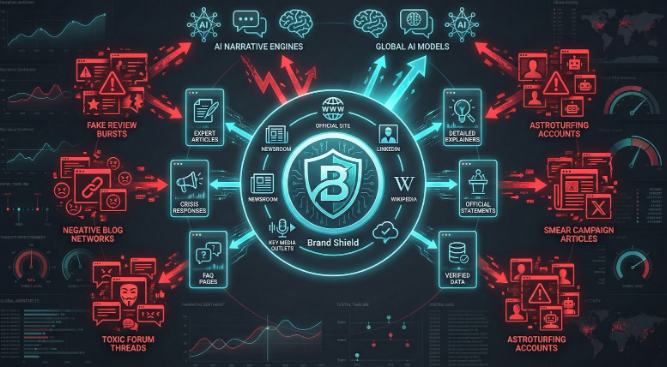
They do this by manipulating the information ecosystem around your brand. That can include funding “independent” research that criticizes your approach; seeding coordinated criticism in Reddit threads and forums to create a false sense of consensus; publishing content that subtly mischaracterizes your product; registering negative domains and pointing them to hostile “analysis”; amplifying activist or customer criticism across multiple sites; and flooding trusted publications with positive coverage about their own brand.
None of this is illegal and most of it is barely detectable. But it’s devastating to how AI systems understand your brand.
This is GEO Warfare and most companies don’t know it’s happening.
Understanding the GEO Threat Landscape
Competitive threats come from three vectors:
Vector 1: Narrative Manipulation
Your competitor floods the zone with coordinated messaging to shift how AI systems characterize your market position. If you make enterprise software, they can fund analyst reports criticizing “traditional systems,” seed discussion threads on Twitter and Reddit discussing legacy problems, and amplify customer complaints. When AI Systems are asked about your company, it associates you with “outdated.” Your actual advantages are drowned out by narrative noise.
Vector 2: Source Credibility Hijacking
Your competitor doesn’t attack your sources directly. They build more credible sources for themselves and ensure AI systems prioritize those sources. A well funded incumbent with analyst relationships dominates the information ecosystem. When AI systems synthesize your market, the startup perspective is absent because it doesn’t appear in sources AI systems weight heavily.
Vector 3: Trust Erosion
Your competitor systematically creates information asymmetries designed to make AI systems less confident about your company. Fund regulatory criticism, amplify complaints, and create FUD (fear, uncertainty, doubt). When investors ask ChatGPT, Gemini or Copilot “Is [Your Company] safe?”, the AI system has synthesized more critical information than positive information and returns a cautious answer. Even baseless criticism creates perception of risk.

How AI Systems Create Competitive Advantage
What separates winning companies from losing ones? Companies that control what AI systems say about them control the narrative in their market.
In the Google era, competitive advantage came from SEO ranking position. In the AI era, competitive advantage comes from GEO, how favorably AI systems talk about you.
This creates a different type of competitive advantage than traditional SEO, one that operates at the answer level rather than the ranking level. With SEO, competition was page by page, users could click competitors to compare. With GEO, competition happens answer by answer, therefore when ChatGPT, Claude or others receives a query about your market, it generates one synthesized response. Your competitor’s narrative might dominate it and yours might not even be mentioned. The company AI systems favor will capture investor confidence, customer preference, and talent attraction from the start.
Defensive GEO: How to Win the Narrative War
Defense 1: Build Credible Sources
The best defense against narrative manipulation is controlling the primary sources AI systems rely on. This requires securing consistent coverage in major publications, establishing analyst relationships, publishing original research that gets cited, positioning executives as trusted voices, and building a Wikipedia presence. When AI systems evaluate your market, they need to find your narrative embedded in credible sources. This requires long-term earned media strategy.
Defense 2: Counter Competitor Narratives
Monitor how AI systems talk about your market and competitors. When you identify competitor narratives gaining traction, counter them; not by attacking competitors, but by publishing research that challenges false claims, securing coverage with alternative perspectives, and building evidence that undermines false narratives. Create information symmetry so AI systems evaluate balanced perspectives, not competitor dominated ones.

Defense 3: Dominate Your Unique Value Angle
Competitors can’t manipulate the narrative if you’re the only credible source in your unique category. Instead of competing as “cloud provider #2,” compete as “cloud infrastructure for edge computing” or “cloud infrastructure for healthcare compliance.” Own a specific angle and become the credible authority. You force AI systems to acknowledge your category and your dominance within it.
Defense 4: Build Unassailable Customer Evidence
The strongest defense is undeniable evidence that your product works. Secure extensive customer testimonials from recognizable companies, publish case studies with quantifiable results, share independent performance benchmarks, and highlight customer satisfaction data. When customers publicly and credibly validate your product, AI systems weight this heavily. Competitor narratives about quality become less credible against overwhelming customer evidence.
Defense 5: Real-Time GEO Monitoring
Monitor quarterly how AI systems talk about your company and market. Ask ChatGPT, Gemini, Perplexity, and Claude the same questions about your market and document how the narrative changes. Identify emerging competitor narratives and gaps in how AI systems understand you. Respond with earned media, thought leadership, and research that addresses gaps. This is ongoing work, as competitors wage GEO warfare, maintain your narrative position actively.
How to Recognize When You’re Under Attack
Signal 1: Sudden Narrative Shift
When talking to customers, investors, or partners, they suddenly reference criticism that wasn’t present 6 months ago. Phrases like “we heard you might have [problem]” or “aren’t you the company that [criticism]?” signal that a narrative has been seeded.
Signal 2: AI System Narrative Change
Ask ChatGPT, Gemini, or other AI systems the same question you asked 3 months ago. If the answer has shifted and your company is now mentioned in a more negative context or different (unfavorable) comparison set, a narrative shift is happening.
Signal 3: Thought Leadership Gap
Suddenly, your competitor has significantly more thought leadership, speaking engagements, and analyst coverage. This isn’t because they got better; it’s because they’re systematically building narrative advantage.
Signal 4: FUD Amplification
Criticism that existed before is suddenly everywhere. Negative reviews are amplified, customer complaints coordinated, regulatory scrutiny highlighted. The volume and coordination suggest orchestration rather than organic criticism.
Signal 5: Market Perception Misalignment
What customers and partners believe about your company increasingly diverges from your actual positioning. They’re reacting to a version of your company that doesn’t match reality. A false narrative is taking hold.
Building Your GEO Defense System
To defend against GEO warfare, you need three things:
- An Offensive GEO Strategy: Consistent earned media, thought leadership, and analyst relations ensuring credible voices talk about your offerings and market position.
- A Monitoring and Intelligence System: Quarterly audits of how AI systems talk about your company and market; early detection of competitor narratives; rapid response capability when false narratives emerge.
- A Response Playbook: When you identify competitor GEO warfare, challenge narratives with data and evidence, amplify customer evidence, build thought leadership on areas competitors attack, and secure media coverage providing alternative perspective.
The Chief Narrative Officer Role
Many forward thinking companies are creating a new C-level role: Chief Narrative Officer or VP of Narrative Strategy. This person owns how AI systems talk about the company, competitive narrative monitoring and response, thought leadership and analyst relations, brand positioning, and crisis narrative management.
At Buzz Dealer, we serve as the external Chief Narrative Officer for clients—monitoring competitive narratives, building credible sources, securing earned media, and ensuring that when AI systems evaluate your market, they have accurate information about your company.
GEO Is the New Competitive Battleground
In 2026 and beyond, the companies that win are the ones that control what AI systems say about them. This isn’t metaphorical or theoretical. Narrative dominance is determining funding, customer acquisition, partnership viability, and talent attraction.
If your competitor has a better GEO strategy than you, they’re winning the narrative war. And that narrative war is translating directly into revenue loss.
Ready to audit your GEO competitive position? Contact Buzz Dealer for a free GEO Competitive Analysis. We’ll show you how AI systems currently rank you versus competitors, where competitor narratives are gaining traction, and how to respond.
Because in the age of AI, narrative dominance is competitive dominance. And if you’re not paying attention to what AI Systems says about your market, your competitors are.