It’s Just Trustpilot: What Business Owners Need to Know About the New Review Rules – and How to Take Their Reputation Back
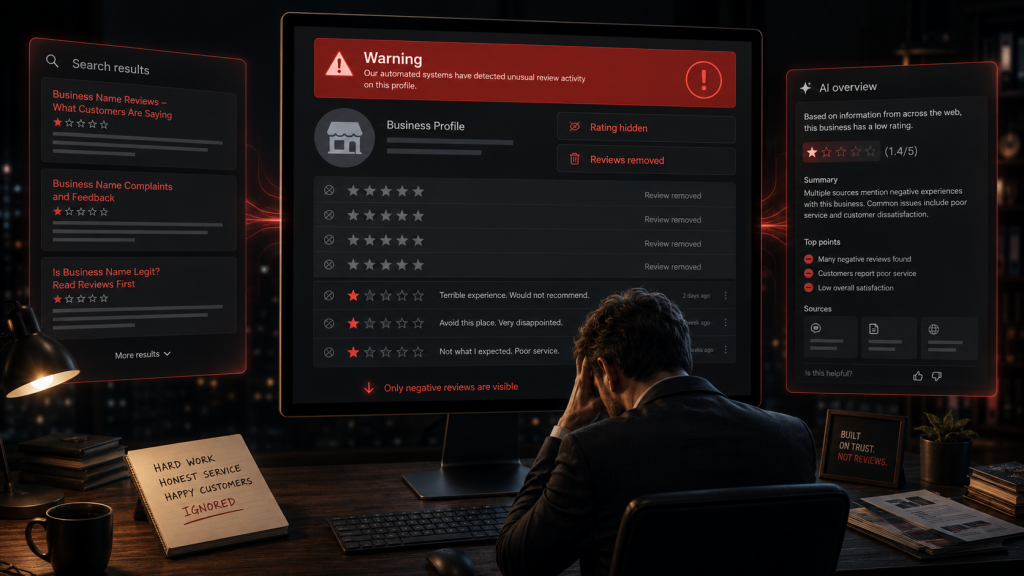
You did nothing wrong. You run a good business, your customers are happy, and your reviews have reflected that for years. Then, over a few weeks, genuine five-star reviews started “disappearing” while seemingly fake one-star reviews remained untouched. A red warning appeared on your profile, your star rating became hidden, and your search results took a hit. Nobody spoke with you, warned you or asked you anything. Nobody showed you any evidence. And there is no way to make it stop.
If this is you, read on, because this is not bad luck, and it is not any indication of a failure on your part. It is the predictable result of a rule change that handed one platform unprecedented power and simultaneously almost zero accountability. Here is what actually happened, why honest businesses are hit hardest, and the calm, practical way to take back your reputation.
First, What Is A Review, Actually
User-generated reviews are exactly what they sound like: opinions written by members of the public, not verified facts, not audited data, just whatever someone felt like typing.
The entire system runs on an unspoken deal; The platform assumes most people are honest, the reader assumes the reviews are real, and the business assumes it will be judged fairly.
When that deal holds true, reviews are useful. When it isn’t honored, they become a weapon, and lately that deal has been irrevocably broken.
How Trustpilot Became So Powerful
Over the years, Trustpilot has grown into a giant for one simple reason: it is an open platform. Anyone can post a review of almost any business, whether invited to or not, and a business cannot simply delete its own profile because it does not like what is being said there.
That openness made Trustpilot enormous and gave it the air of a neutral public record. Search engines trusted it, so it ranked. Because it ranked, more people landed on it. Because more people landed on it, businesses felt they had to be there. That loop, not perfect accuracy, is what made Trustpilot powerful.
But here is the thing most owners miss: people don’t usually go to Trustpilot because everything went fine. They go there when they are angry enough to say something publicly. It became, in practice, a public complaint magnet with a five-star logo on top. Hold that thought, because it matters enormously later.
The Bias Nobody Talks About
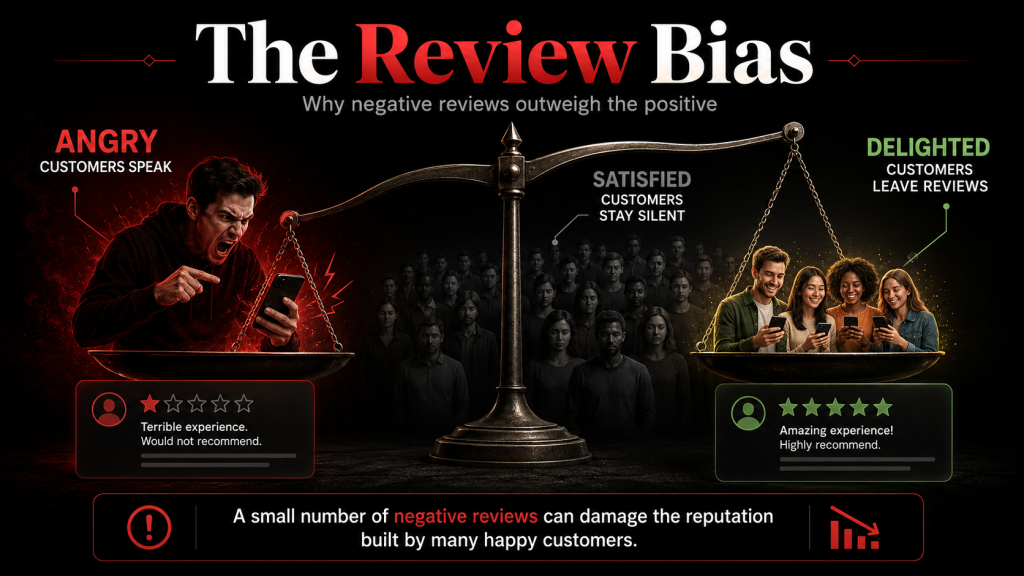
Voluntary reviews are not a fair or accurate sampling of your customers. They never were. Just think for a moment about who is actually motivated enough to sit down and write a review.
The furious customer writes immediately, often before the issue is even resolved, sometimes specifically to hurt you or apply pressure. Anger is rocket fuel for a bad, one-star review.
But the overwhelming majority of satisfied clients that any good business has, writes nothing. They got what they paid for, were satisfied, and they moved on. Leaving a review never crossed their mind.
Only the rare, genuinely delighted customer goes out of their way to praise you, and even then, usually because they were incentivized to do so (someone from your team or an automated email from your company asked them to).
So the natural state of voluntary reviews is skewed: loud negatives, silent positives, and a thin sliver of enthusiastic fans. Every honest business is fighting against that disparity from day one. It is not paranoia. It is the math of human behavior.
The Damage Cuts Both Ways
Now to the part that has been largely ignored due to all the noise around the topic of cleaning up reviews.
Yes, fake reviews are a real problem for consumers. A dishonest business can buy glowing praise it never earned and trick people into trusting it. Cracking down on that is a legitimate goal, and no honest business objects to it.
But there is an equal and opposite damage that barely anyone is talking about: the crackdown itself is now hurting honest businesses, from the exact opposite direction.
A genuinely excellent company can be made to look mediocre or worse, not by buying anything, but by having its real praise stripped away and its junk criticism left standing. One distortion makes bad businesses look good. The other makes good businesses look bad. Both deceive the consumer. Only one is being treated as the enemy.
What Has Changed, In Plain English
Here is the shift, stripped down to the essentials.
First, fake reviews are now treated much more seriously. Review platforms are expected to take stronger action against them, and if they fail to do so, they may face legal or regulatory problems. In other words: The platform itself can now be fined if it gets this wrong.
Second, the riskiest mistake for the platform to make became leaving up or removing the wrong negative review, because suppressing genuine criticism is exactly what regulators are hunting for. Deleting a positive review, by contrast, carries no penalty at all. It even looks like diligent anti-fake-review work.
Third, follow that incentive to its logical end. A platform protecting itself will now prefer to keep negative reviews, including dubious ones, because removing them is risky – and will become much more “trigger happy” in removing positive reviews, because nobody will ever punish it for that. Your honest five-star reviews became the safest thing in the world for it to delete.
Even the platform’s own verification check is rigged with the same bias. When it emails two customers to confirm their experience, one who had a bad time and one who had a good one, who do you think is incentivized to reply, for free, with nothing offered in return? The angry one, of course – every time. The happy customer cannot be bothered. So, the very step that is meant to sort real reviews from fake reviews tilts the same way as everything else: against the business who’s genuine, happy customers simply won’t jump through hoops to prove their satisfaction.
Fourth, and this is the quiet scandal – the platform can brand you publicly as a suspect of bad behavior without actually having to prove you did anything wrong. It does not have to show which reviews it removed, what triggered the decision, or any evidence that you were involved. You are punished for content posted by strangers, content you did not write, did not ask for, and could not have stopped.
Put those four together and you get the nightmare scenario that honest businesses across multiple vectors are now living through as these lines are being written: you cannot meaningfully defend yourself, and the platform can do more or less whatever it wants. That is not a bug, it’s a built-in feature, by design.
And it is easily manipulated and abusable. If their system will brand you a “bad actor” the moment a cluster of fake-looking positive reviews appears, that means anyone, a competitor, a disgruntled ex-employee, a random troublemaker, can trigger that action against you on purpose. A penalty that is easy to weaponize at an innocent target cannot be a fair basis for punishing anyone.
So What Can We Actually Do?
First, take a breath. There is a clear, quick , and cheap path forward, and none of it requires you to go too far out of your way.
Put It On Record, Immediately
Screenshot everything first: the warnings, the removal notices, your rating history, your customer records, all dated, before anything changes. Then put your objection in writing to the platform and make them show their work. Demand that they identify the reviews they removed, disclose what triggered it, and prove you were responsible, or else remove the warning, reinstate your genuine reviews, and stop the over-removal. They almost certainly cannot prove your involvement, because there is nothing to prove. Their non-answer is not a dead end. It is your evidence.
Use The Free Appeal Option
If you have customers in the EU, you have rights most owners never use. The platform is legally required to give you real reasons, to let a human (not just an algorithm) review the decision for free, and to allow an independent external appeal. Those independent appeals overturn a large share of the cases that reach them. Your genuine reviewers can use the same path for their own removed reviews. It costs nothing and it is your single best shot at a concrete reversal.
Tell The Regulators
A complaint to the platform’s home regulator and to consumer authorities costs nothing and adds outside pressure. One business is easy to ignore. The behavior, documented, is not.
Manage The Account Itself
You cannot delete the profile, but you control your bio and your replies, and you can use them to redirect. State the page’s condition plainly and point people to where your real feedback lives. Something like: “This profile is no longer actively monitored due to a high volume of unverified and spam reviews. For verified client feedback, please see [platform A] or [platform B].” Keep it factual, vary the wording, never attack the platform directly, and always engage a genuine complaint with a real way to reach you rather than a brush-off.
The Reframe That Changes Everything: It’s Just One Source
Here is the mindset shift that matters most, and it is the one your competitors that are panicking over their Trustpilot score will almost surely miss.
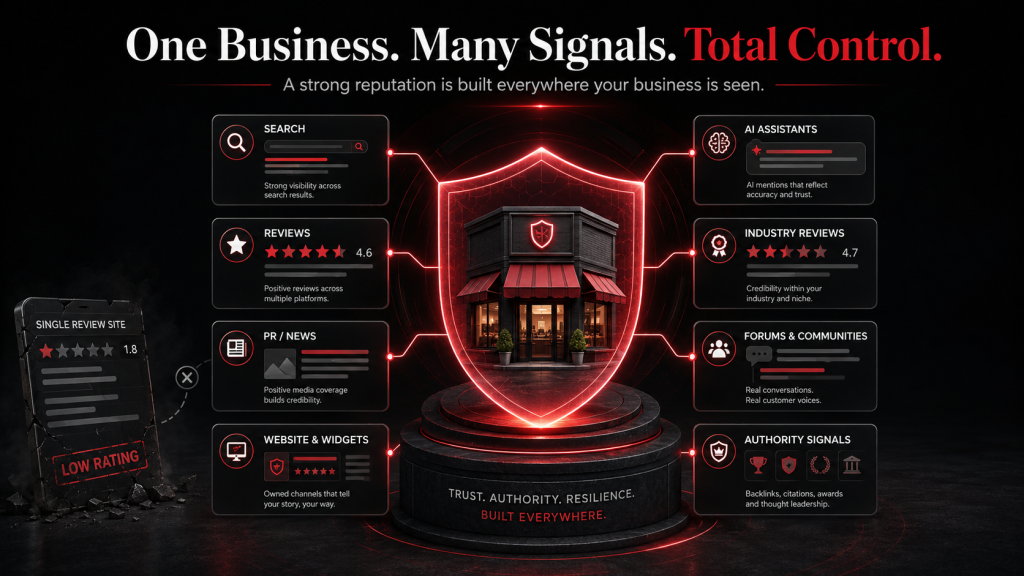
Trustpilot is but one review source among many, and not even the one most people trust. When someone wants to know if you are any good, where do they actually look? – They Google you. They ask ChatGPT and other AI assistants. They check the platforms specific to your industry. They read Google reviews, forums, Reddit threads, and whatever else surfaces.
AI assistants which have increasingly become one of the main methods that people use to form first impressions, do not treat Trustpilot as the last word. They pull from many platforms, general and industry-specific, and weigh some far more heavily than others. They read forums and communities. And they read your Trustpilot replies too, which means a calm, factual note explaining that the page is no longer monitored because of fake reviews doesn’t just speak to human visitors. Over time, the AI engines learn to repeat it.
So, stop letting one website define you and build the online narrative you want to be known for everywhere else instead. Nurture your Google reviews. Get active on the platforms that actually matter in your sector. Move your verified customer reviews onto verified platforms, the ones that only accept invited, identity-checked reviews, because a fake-positive sabotage wave physically cannot land there. Put a review widget on your own website. Make the authoritative, fair, verifiable version of your reputation so visible and so consistent across so many sources, that one distorted page doesn’t become a primary source of truth, but a mere footnote.
The Bottom Line
So breath,, and let’s put this in the proper proportion. A for-profit company was handed an unusual, largely unaccountable power to damage businesses without paying any price for getting it wrong. That power is real, it is unfair, and it is worth pushing back against with every cheap, fast, legitimate step above. But it is also strange, unexplained, and the kind of overreach that tends to get reined in over time.
And in the meantime, remember: It’s just Trustpilot. One platform. One Source. One Page. If you take the immediate, low-cost steps, if you manage the page instead of fighting it, if you nurture the fairer platforms and let the fuller picture of your business shine everywhere people actually look, then Trustpilot shrinks back to what it really is: a single unreliable page about you, on a site people visit to complain, surrounded by a strong, positive reputation that you control.
You are not powerless, and you are not defined by your worst week on one website. Put it in context, do the work on every other front, and you are going to be fine.