
Why AI Makes Organic Marketing Your Smartest Spend
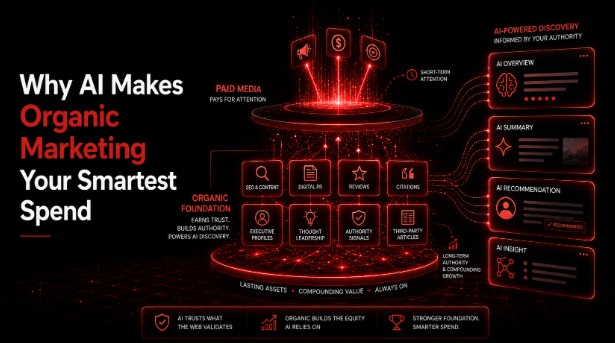
Every marketing leader knows the budget conversation that surfaces when targets get aggressive and the pressure to stack the pipeline is high. The logic almost always points the same way: put the money into channels that produce the clearest, fastest, easiest-to-measure return.
Usually that means lead generation, and for good reason. If you need leads this quarter, paid campaigns are far easier to defend than long-term organic work. You can track spend, clicks, CPL, CPA, conversions and revenue. You can show the board exactly what the money did.
Organic marketing has never offered that kind of clean accounting. SEO, Digital PR, content, reputation management, authority building – their impact is cumulative, spread across dozens of touchpoints, and rarely traceable to a single line on a dashboard. So when budgets tighten, organic is often the first place businesses go looking for savings.
But that reflex is now starting to cost brands more than it used to. Not because lead generation matters less, but because AI has quietly changed the value of the organic assets companies have spent years building.
Organic Marketing Was Already Important. AI Made It More Valuable.
For most of the last decade, organic marketing played a supporting role. A prospect saw an ad, searched the brand, checked out the brand’s website, skimmed a few online reviews, maybe read a comparison piece, then decided whether to go further. In that sequence, SEO, reputation management and third-party content did their work after interest already existed. They validated the brand rather than introduced it.
That role hasn’t disappeared, but it’s no longer the whole story. Customers aren’t only searching manually anymore. They’re asking AI assistants, reading AI Overviews, and leaning on summaries and side-by-side comparisons before they decide which companies are worth a closer look.
None of this has replaced Google, paid media or old-fashioned research. What’s changed is the first layer of evaluation. When someone asks an AI engine which broker to consider, which PSP is reliable, or what people actually say about a given company, the answer isn’t drawn from that company’s homepage or its latest campaign. It’s assembled from the broader digital footprint around the brand, and that’s exactly where organic marketing lives.
The Same Assets Now Influence More of the Journey
Think about the assets themselves. A Digital PR placement used to be filed under coverage, authority and a bit of SEO value. A review strategy was a conversion tool. An executive profile was personal branding. A well-placed industry article was visibility and credibility.
All of that still holds. What’s new is that these same assets now carry extra weight, because they help shape how AI systems and search engines understand a brand in the first place. The asset didn’t change; its value did.
A strong third-party article isn’t just something a prospect reads after searching your company; it can become part of the material AI systems draw on when they answer a question. Reviews do more than sit on a platform as social proof – they can shape how a brand gets described and compared across AI discovery. Digital PR was never only about landing the publication; it builds the authority signals that carry across search, AI and human perception alike.
This is the piece most budget conversations miss. Businesses still evaluate organic marketing as though it only feeds traditional search and conversion. In practice, it now touches a far wider stretch of the journey.
The Budget Mistake Is Treating Organic as Optional
The mistake isn’t prioritising lead generation. Every serious strategy needs a pipeline engine. The mistake is treating organic as the flexible line item, the thing you trim first, simply because its return is harder to explain on a short timeline.
Paid acquisition is immediate but temporary. Switch the campaign off and the traffic stops with it. Organic works on a different foundation. It produces assets that keep influencing perception long after the initial spend. A strong article doesn’t vanish when the monthly budget resets. A high-authority mention stays put. A healthy review profile keeps reassuring prospects. A reputation built across credible third-party platforms goes on doing its job for months.
That has always been organic’s real advantage. AI has just made it much harder to ignore, because those same assets now shape the answers and summaries people rely on before they ever reach your website.
Paid Generates Attention. Organic Builds Confidence.
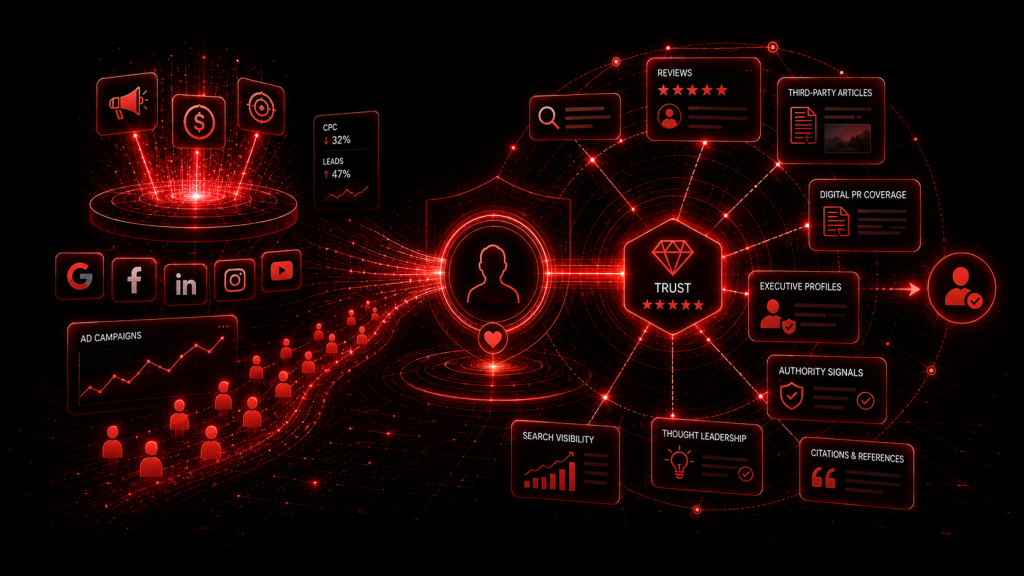
Which is why the “paid vs. organic” equation is the wrong formula in 2026 and beyond. Paid gets a brand in front of people. Organic helps those people decide it’s worth their trust and money.
In crowded, trust-sensitive industries like FX, fintech and PSPs, that distinction is everything. Almost nobody converts because they saw one ad. They convert because everything they find afterwards makes the company look credible, active and relevant. When the search results are thin, the reviews are inconsistent, and AI platforms have little authoritative information to pull from, paid campaigns have to carry all that weight themselves. The lead might still come in, but the trust gap is wider and the cost is higher.
Flip it around and strong organic foundations make paid efforts more efficient. The ads spark the attention; the surrounding footprint closes the confidence gap. That’s the balance worth protecting.
AI Has Changed the Cost of Underinvesting
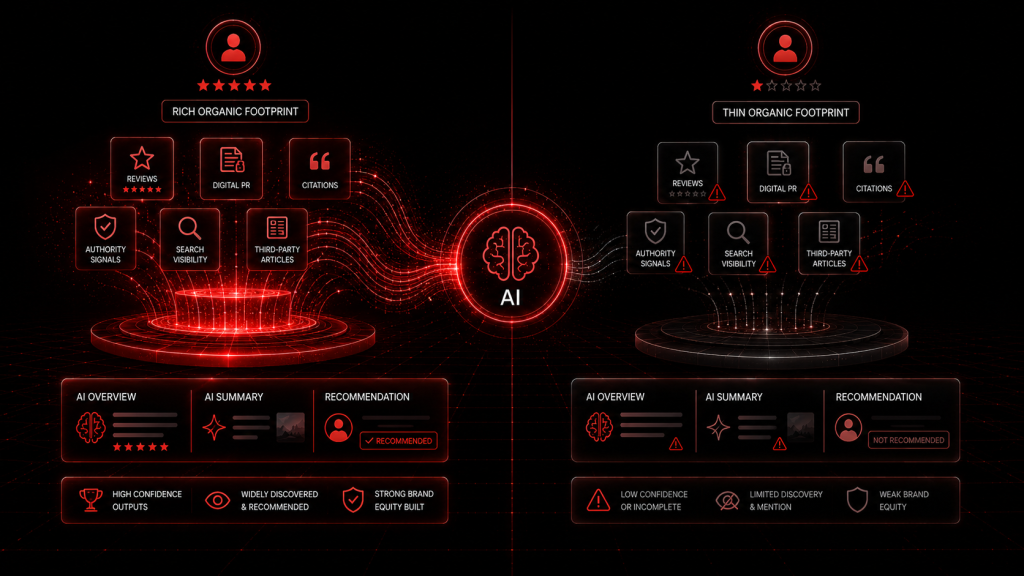
Underinvesting in organic has always had consequences, but they used to arrive slowly and quietly: a slipped ranking here, a missed PR opportunity there, a competitor pulling ahead on authority over a year or two.
Now the cost shows up faster and in plain sight. If AI platforms are part of the research journey, brands with richer digital footprints have more third-party information to be referenced, more authority signals across the web, and more chances to be represented accurately. Brands with a thin presence face the opposite: they get underrepresented, incorrectly described, or left out of the answers prospects are using to make decisions.
That’s a real exposure. Not because AI is flawless, it isn’t, but because behaviour is shifting. People are consuming faster summaries, fewer individual sources, more AI-assisted answers. In that environment, treating organic as an afterthought is a harder position to defend.
The New Balance
The strongest teams won’t pull back from lead generation. They’ll rebalance, continuing to build their pipeline while also investing in the assets that make a brand easier to discover, trust and understand across search, AI, review sites, industry publications and third-party sources.
SEO, Digital PR, reputation management, content, review strategy and authority building all still matter. What’s changed is that they’re no longer separate, disconnected items on a marketing menu. They’re the infrastructure that determines how a brand gets discovered and evaluated in the first place.
For marketing leaders, that reframes the budget question. It’s no longer only “How much do we need to spend to generate leads this quarter?” It’s also “What are we building today that will still be supporting trust, visibility and authority six months and a year from now?”
Final Thoughts
Lead generation will always earn its place in the budget. But a business that leans too hard on short-term acquisition while starving the long-term organic foundations around it is trading a manageable problem now for a bigger one later.
AI has raised the value of organic marketing by widening the role those assets play. The same reviews, articles, mentions, citations and authority signals that once supported SEO and conversion are now helping shape how brands are understood across AI-powered discovery. That doesn’t make organic a replacement for paid efforts. It creates the foundation that paid efforts increasingly rely on.
The companies that see this early won’t be the ones that abandon lead generation. They’ll be the ones that stop treating organic marketing as optional or secondary. Because in the age of AI, brands that invest only in being seen risk losing ground to the brands that invest in being trusted.