
What an Online Reputation Audit Covers, and How to Run One
Last updated: 28 September 2026

An online reputation audit is a structured read of everything a person or an AI assistant finds when they look up your name or your company: search results and Google’s AI summary, review platforms, news coverage, profiles, and the answers AI engines give. It records what is there, who controls it and what it says, and grades it, so that a plan starts from facts.
This guide lists what a proper audit covers, how a company audit differs from a personal one, how the findings are graded and read, and what you can check yourself in an hour before deciding whether you need the full version.
What an online reputation audit covers
A reputation lives in three places, and an audit that reads only one of them is a partial answer. The first is the set of AI engines people now ask directly. The second is the search surfaces, which still decide what most people see first. The third is the shared sources both of them draw on: review platforms, knowledge panels, encyclopedic and company records, and the press. The table below is the covering list, in the order a professional audit works through it.
| Surface or signal | What is recorded | How it is judged |
|---|---|---|
| AI recognition | Whether each of six AI engines (ChatGPT, Claude, Gemini, Grok, Perplexity, Copilot) identifies you correctly when asked | Recognized or not, per engine; “I don’t know” does not count |
| AI sentiment | How each engine summarizes what people say about you | Positive, mixed, negative or no data, per engine, and how many of the six are positive |
| Legitimacy (companies) | Whether each engine describes the company as trustworthy | Legitimate, Questionable or Illegitimate |
| Category rankings and share of voice (companies) | Where engines place you when asked for the best providers in your category, and how often you appear against competitors | Rank per engine; engines present, average and best position |
| AI citation sources | Which websites the engines lean on when they answer questions about your category | Listed, not scored: this is the map of where influence sits |
| AI mentions footprint | Whether you have a measurable presence in AI answers at large | Established, or not yet established |
| Google results | Every result for the exact name and its common variants, in each market and language | Each result classed Positive, Neutral, Negative or Non-Relevant; non-relevant results are set aside so they do not distort the picture |
| Google AI Overview | What Google’s own AI summary says about you | Sentiment, read as a line of its own |
| Autocomplete | The suggestions Google offers as the name is typed | Relevant and positive, relevant and neutral, relevant and risky, or non-relevant |
| People also ask, related searches, images | The questions and pictures Google attaches to the name | Recorded and shown; images matter more for people than for companies |
| Organic footprint (companies) | How visible and how authoritative the company’s own site is in search | Visibility and link-authority metrics |
| Technical AI visibility (companies) | Whether AI crawlers can read the site, whether it depends on JavaScript to render, whether an llms.txt file exists and is valid, and how often the site publishes | Pass or fail per check; cadence active, occasional or dormant |
| Review platforms (companies) | Rating and review count per platform, Google Business Profile included | Per platform |
| Authority signals | Knowledge panel (yours, someone else’s, or unconfirmed), Wikipedia, Wikidata, Crunchbase, LinkedIn | Present or absent, and whether each points at the right entity |
| Awards and certifications (companies) | Third-party recognition found by search | Listed |
| Earned media | Press coverage, with high-authority outlets recognized from a curated list | Listed, weighted by the outlet |
Two things about this list matter more than any single row. First, it is read per market and per language. A company can be described well in English and badly in German, and a person can have a clean first page in one country and an old story on top in another. Second, “no data” is a finding. An engine that has never heard of you, or a review platform with no page for you, tells the auditor something specific about where you stand.
A company audit: three pillars and a grade
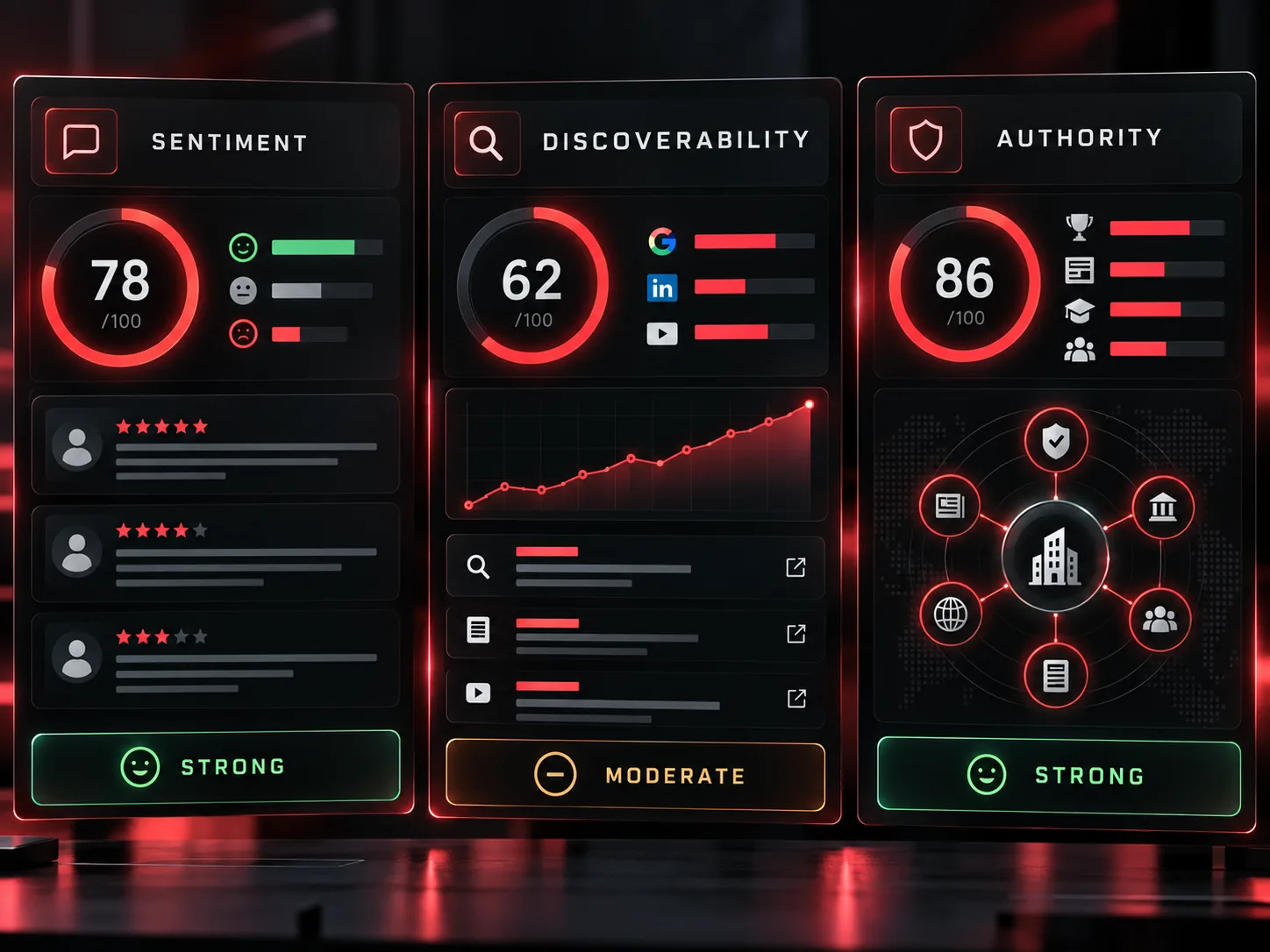
For a company, the surfaces above roll up into three pillars, each graded from 0 to 100 and given a verdict: Strong (70 and above), Moderate (40 to 69) or Weak (below 40). There is deliberately no single combined score. A company with a strong reputation that nobody can find has a different problem from a company everyone can find and nobody trusts, and one number would hide the difference.
Sentiment is what people and engines say about you: the sentiment each AI engine reports, the class of every Google result for your name, the AI Overview, the review platforms, and the questions attached to the name. It is the pillar that blocks trust when it is low, and it is worked first whenever it sits below 70.
Discoverability is whether you are found at all: recognition by each engine, your position in category answers, your share of voice against competitors, the sources the engines cite, your presence in AI answers generally, and the technical layer that decides whether AI systems can read your site.
Authority is the foundation the other two are built on: the knowledge panel, Wikipedia and Wikidata, Crunchbase and LinkedIn, awards and certifications, and press coverage from outlets that carry weight. Engines check facts against these sources before they repeat them. When Authority is thin, Sentiment and Discoverability are both harder to move, which is why the audit treats it as the pillar that lifts the others.
A personal audit: verdicts, not grades

A person is not a category and does not compete for a ranking, so a personal audit works differently. It is organized in three verdict-led pillars plus a search-presence read, and it uses numbers only where they mean something.
Recognition and Accuracy. Do the engines identify the right person, and do they get the facts right? The audit records, engine by engine, whether you are recognized and with what confidence, and counts how many of the six get you. Accuracy is measured against an anchor when one exists, such as a Wikipedia article, a LinkedIn profile, a Crunchbase entry or your own site. When there is no anchor, the audit reports how far the engines agree with each other, which is often the more revealing number.
Sentiment and Risk. How the engines, the search results and the news portray you: which way they lean, what share of what is found is non-negative, and a verdict such as Clean, Mixed or Negative.
Authority and Footprint. Your presence and credibility signals: Wikipedia, Wikidata, LinkedIn, Crunchbase, a knowledge panel and press, expressed as a tier plus a count of signals present. One rule here matters to a lot of people: a person without a Wikipedia page is never marked down. Most people do not qualify for one, and its absence is recorded as an opportunity, not a fault.
Search Presence. Google results for the exact-phrase name and for the broad-match name, Google News, the AI Overview, the knowledge panel, autosuggest with risk flags, image results, Google Scholar, third-party appearances such as interviews and podcasts, and the publishing rhythm of any site you own. Patents appear only where they exist.
Company and person: what the two share and where they differ
| Dimension | Company audit | Personal audit |
|---|---|---|
| AI recognition and sentiment | Yes | Yes |
| Google results and AI Overview | Yes, for the brand and its query variants | Yes, for the exact name and the broad name |
| Autocomplete, people also ask, images | Yes | Yes; images carry more weight |
| Knowledge panel, Wikipedia, Wikidata, LinkedIn | Yes | Yes |
| Category rankings, share of voice, citation sources | Yes | No: a person does not compete for a category |
| Legitimacy, review platforms, awards | Yes | No |
| Site visibility and technical AI access | Yes | Only the publishing rhythm of an owned site |
| Name disambiguation | Rarely an issue | Central: other people with the same name shape the results |
| Google News, Scholar, patents, interviews and podcasts | Press only | Yes |
| Output | Three grades with verdicts | Verdicts, with numbers where they mean something |
The reason for the split is simple. A company competes for a place in a category, so an audit has to measure it against competitors and against the sources that decide the category. A person competes with everyone who shares the name, so the audit has to establish first that the engines are talking about the right human being, and only then ask what they say.
How a professional audit is scored and read
Collection, classification and scoring are automated, and a specialist reviews the result before it goes out: results that belong to another entity are excluded, and the summary is checked by a human who knows the sector. The run itself takes minutes, not days; the reading of it is where the value sits. Our audit system, Atom, is described in more detail in What Brands Should Be Measuring Now, which also explains why search and AI visibility have to be measured together.
Three rules govern how the report is read.
Every gap is tagged by how many pillars it lifts. Some fixes move one pillar: answering a run of reviews moves Sentiment and little else. Some move two. A few move all three: a knowledge panel or an encyclopedic entry lifts Sentiment, Discoverability and Authority at once, which is why they sit at the top of the list when they are attainable. The report labels each gap single, double or triple lift, and the top gaps are always chosen so that they span more than one pillar.
Two pillars are worked at once. Whatever blocks trust today comes first: Sentiment if it sits below 70, otherwise the weakest pillar. The weakest remaining pillar is worked in parallel for growth. The report never points at one “single biggest move”, because reputations are not fixed by one move.
The executive page says what matters. A summary, the strongest signals, the serious weaknesses and a plain statement of where the upside is, followed by the pillar sections and a Gaps and Opportunities list. If the first page does not tell a busy reader what to do, the audit has failed regardless of how much it measured.
What an audit finds most often
Patterns repeat. For companies, five findings account for most first audits:
- Other companies with the same or a similar name crowd the search results and the AI answers, and the engines blend them.
- The company is missing from, or ranks low in, AI answers about its own category, and has no established footprint in AI answers generally.
- The AI engines cite third-party review or comparison sites for the category rather than the company’s own pages, so the company’s story is told by other people.
- The knowledge panel is missing, or it belongs to a different entity.
- One negative review platform, or a risk-flagged autocomplete suggestion, sits among results that are otherwise neutral, and colors everything around it.
For people, the pattern is different:
- The engines confuse the person with others of the same name, or do not recognize them at all.
- Old negative news still ranks for the name years after the event.
- There is no knowledge panel and no encyclopedic entry, and credibility is spread thinly across profiles that do not agree with each other.
- There is no personal website or owned channel, so page one and the image results are controlled by whoever else published.
- The engines know the person but disagree on the facts: title, employer, nationality, dates.
How to run a first check yourself
You can find out whether there is a problem in about an hour. You cannot find out how big it is or where to start, and it helps to know the difference before you begin.
- Open a private browser window so your own history does not shape the results.
- Search the exact name, then the variants people actually use: with and without a middle initial, the brand with and without its legal suffix, the common misspelling.
- Read two pages of results and the AI Overview if one appears. Note what each result is, who published it, and whether it is positive, neutral, negative or about someone else.
- Search the name with “reviews” and with “scam”, which is what a cautious buyer does before a first meeting.
- Type the name slowly into the search box and record the autocomplete suggestions.
- Ask three AI assistants the same two questions: who or what this is, and whether it can be trusted. Save the answers with the date.
What this misses is the rest of the covering list: other markets and languages, the sources behind the AI answers, the technical layer that decides whether AI systems can read your site at all, the review and authority signals engine by engine, and any grading. A self-check tells you whether to worry. An audit tells you what to do first.
From audit to plan
The point of the grades is the plan that follows. A finding that content breaks a platform’s rules or a law leads to removal where it qualifies. A finding that harmful content is accurate and permanent leads to suppression: building and strengthening the pages that should outrank it. A finding that the record is thin leads to rebuilding: the profiles, the facts, the coverage and the answers that should have existed. A finding that everything is in order leads to protection: monitoring and the discipline of keeping the sources consistent so that nothing drifts.
How that work is organized depends on the situation. A live crisis is handled through Reputation ER. Damage that has settled in is the job of online reputation repair. A company that wants its record managed continuously works with us on corporate reputation management, and an individual on personal reputation management. Where the findings sit mainly in what AI engines say, the plan is AI reputation management. Whatever the route, the audit is the first step and the measure the later steps are judged against.
How often to audit, and how to monitor your online reputation between audits
A full audit once a quarter is enough for most companies and most people, and once a year is too little: engines change their sources, review platforms change their rules, and a single article can reset page one in a week. Between audits, monitor the few things that move fastest: new reviews, new mentions of the name in the news, the autocomplete suggestions, and one AI assistant’s answer to “can this company be trusted”, asked the same way each month. When any of them shifts, run the full read again rather than guessing at the cause.
If you would rather have the audit done properly, send us the name and we will tell you what people and AI assistants find, and what it would take to change it.
Frequently asked questions
What is a reputation audit?
A reputation audit is a structured review of everything search engines and AI assistants show about a person or a company: results, reviews, news, profiles and AI answers, read per market and per language. It records what exists, who controls it and what it says, and grades it so that a plan can start from facts.
What does an online reputation audit include?
It includes the answers of six AI engines and the sources they cite, Google results and the AI Overview for the name and its variants, autocomplete and related searches, review platforms, the knowledge panel, Wikipedia, Wikidata, Crunchbase and LinkedIn, awards and press coverage, and for companies the visibility and AI readability of their own site.
What is the difference between a company reputation audit and a personal one?
A company audit grades three pillars, Sentiment, Discoverability and Authority, against competitors and category answers, and covers reviews, legitimacy and the company’s site. A personal audit gives verdicts rather than grades, starts by confirming the engines mean the right person, and adds news, images, Scholar and interviews. The absence of a Wikipedia page never counts against a person.
How long does a reputation audit take?
Collection and scoring run in minutes, not days, across all markets and languages requested. The specialist review of the results and the written plan typically follow within a few working days, depending on how many markets are covered and how much of what is found has to be checked by hand.
How much does an online reputation audit cost?
The audit is priced on its own and depends on the number of markets and languages. The work that follows it is where the larger budgets sit: typically $1,000 to $3,000 a month for a light cleanup, $3,000 to $10,000 a month for standard suppression work, and $10,000 a month and up for regulated or high-profile repair, as set out in our guide to online reputation management costs.
How often should you audit your online reputation?
Once a quarter for most companies and public-facing individuals, and immediately after any event that changes what people search for: a funding round, a leadership change, a lawsuit, a viral post or a run of reviews. Between audits, watch new reviews, news mentions, autocomplete and one AI assistant’s answer to a trust question each month.