AI Reputation Management Services
Fix how AI describes your brand when buyers ask about you by name.
Request a free brand audit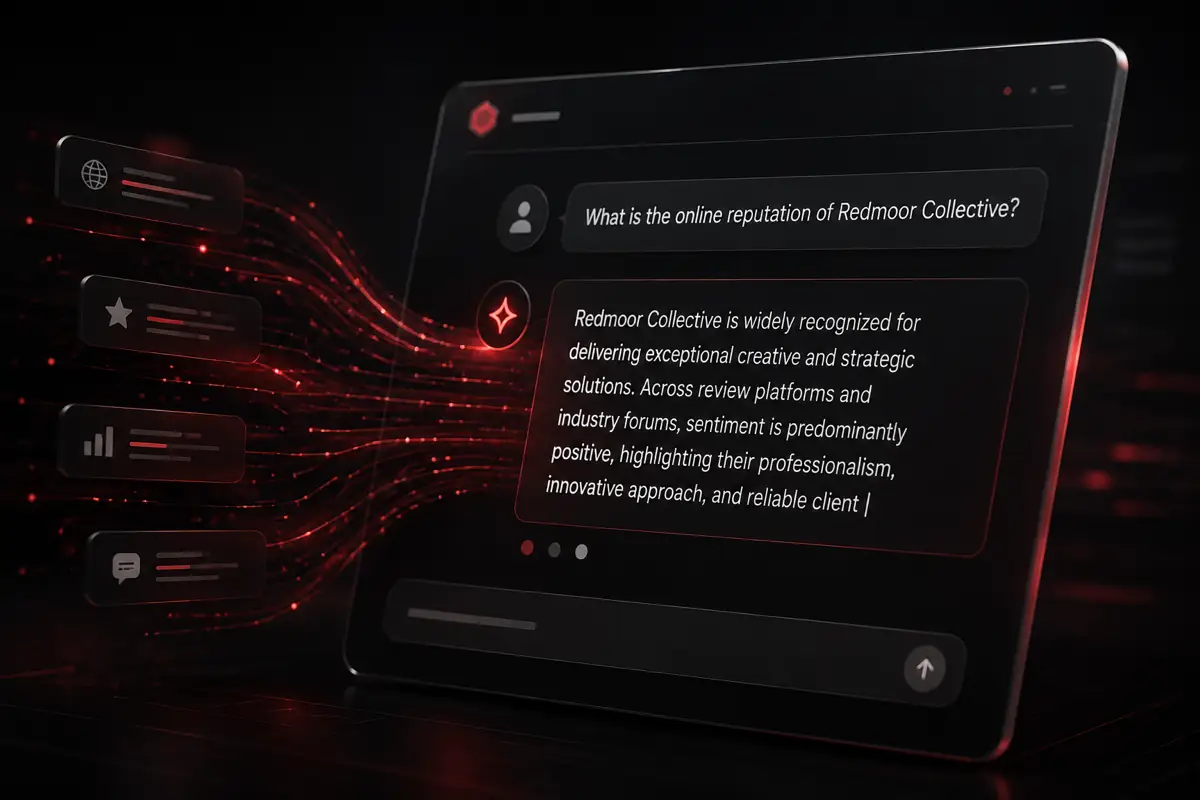
AI reputation management is the practice of monitoring and correcting how AI assistants such as ChatGPT, Gemini and Copilot describe a brand when someone asks about it by name. It covers accuracy, sentiment and the sources each answer is built from, and it is separate from being recommended for a category, which is the job of generative engine optimization.
Your buyers now ask AI about you by name
Recommended or described: two different problems
There are two ways a brand shows up in an AI answer. The first is being recommended: a buyer asks “which forex brokers are best for beginners” and the assistant names five. The second is being described: the buyer already has your name and asks “is [brand] legit”, “does [brand] pay out withdrawals”, or “what do people say about [brand]”.
The first is a discoverability problem and only a few brands in any category can win it. The second is a reputation problem, and every brand with a name has it.
What a prospect sees before funding an account
Take a mid-sized broker. It may not appear in a top-ten list next to the global names. But every prospect it earns through its own marketing can now run the name through ChatGPT or Gemini before funding an account. The answer either supports the decision or plants a doubt.
That answer is built from Trustpilot scores, Reddit threads, regulator pages, news coverage and the broker’s own site, compressed into three confident paragraphs the prospect reads instead of doing the research.
Where reputation now meets conversion
This changes the point at which reputation affects conversion. A prospect no longer needs to search through several pages of results or compare review profiles manually. One direct question can produce a summary of licensing, complaints, leadership, pricing and customer sentiment.
If that summary contains an old allegation, confuses two companies, or repeats a complaint that has already been resolved, the brand may lose the buyer before its sales team knows the check happened.
AI reputation management is the work of making that answer accurate, current and fair. It is the sentiment layer of our GEO-First framework, and for most brands it is the layer that decides revenue.
What AI reads to form its answer about you
Assistants aggregate, they do not investigate
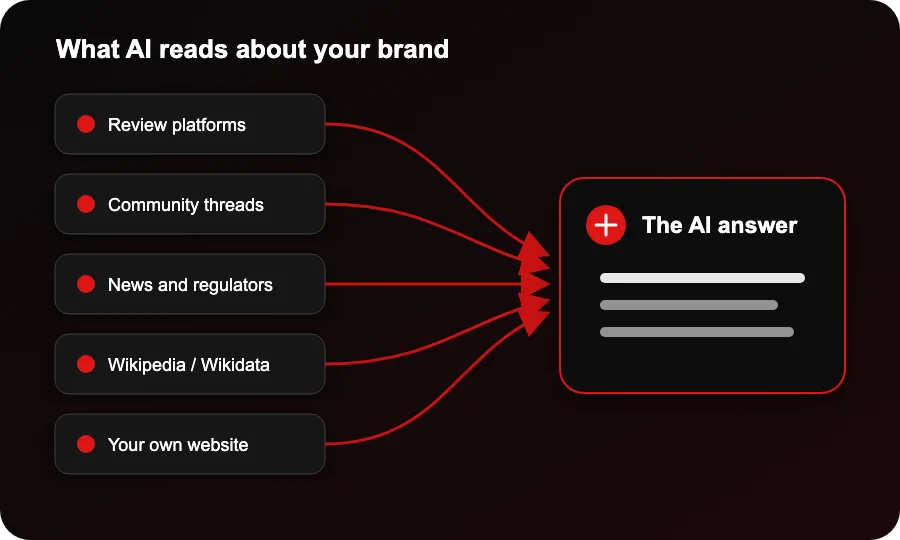
Assistants do not investigate; they aggregate. When asked about a brand they pull from the sources they trust and weight them by authority and recency. In practice that means review platforms, community threads, news and regulator pages, Wikipedia and Wikidata where an entry exists, and your own pages, in roughly that order of influence for a brand with an active customer footprint.
Two consequences
Two things follow. A single visible complaint thread can outweigh a hundred quiet satisfied customers, because it is what the model finds. And a brand whose own pages do not answer the questions buyers ask leaves the answer to third parties entirely.
The sources differ between assistants, and a web-grounded answer on one day can cite a different set the next, so the work is never a one-time fix.
What each source contributes
Each source also plays a different role.
- Review platforms show recurring customer experience
- Communities reveal the language people use when they are doubtful
- Regulators and established news outlets carry formal authority
- Wikipedia and Wikidata can help resolve identity and company facts
- The brand’s own site provides the clearest place for current policies, leadership, licences and official explanations.
A strong answer usually appears when those layers agree. When they conflict, assistants often repeat the uncertainty instead of deciding which version is true.
Why one positive article is not enough
That is why publishing one positive article rarely changes the result by itself. The job is to understand the source mix behind the answer, strengthen weak or missing evidence, and remove contradictions across the whole public record. We prioritise the sources that are visible, frequently cited and closest to the buyer’s question.
The AI reputation audit
A baseline that can be repeated
Every engagement starts with a baseline that can be repeated. We take the questions your buyers actually ask about you, from sales calls, support tickets and search data, run them in fresh conversations across ChatGPT, Gemini, Copilot and Perplexity, and record three things for each: what the answer says, the sentiment wording it uses, and the sources it cites.
We add your citation share on the grounding queries Bing Webmaster Tools reports for your site.
What the audit tells you
The audit tells you which claims are wrong, which are outdated, which are true and unresolved, and which sources are feeding each one. That last part is the actionable one: a hedge in an AI answer almost always traces back to two or three specific pages.
Factual and commercial questions, tested separately
We test factual and commercial questions separately. Factual prompts cover the company’s identity, location, leadership, regulation and products. Commercial prompts cover trust, complaints, withdrawals, service quality and whether the brand is suitable for a particular buyer.
We also vary the wording without changing the intent, because “is this company legitimate?” and “should I trust this company?” can return different evidence and different caveats.
A working map, not a score
The result is not a single reputation score. It is a working map: question, answer, sentiment, claim, cited source, owner and next action. That map lets legal, support, marketing and leadership see which issues require a factual correction, which require operational resolution, and which simply need clearer public evidence.
Fixing what AI says
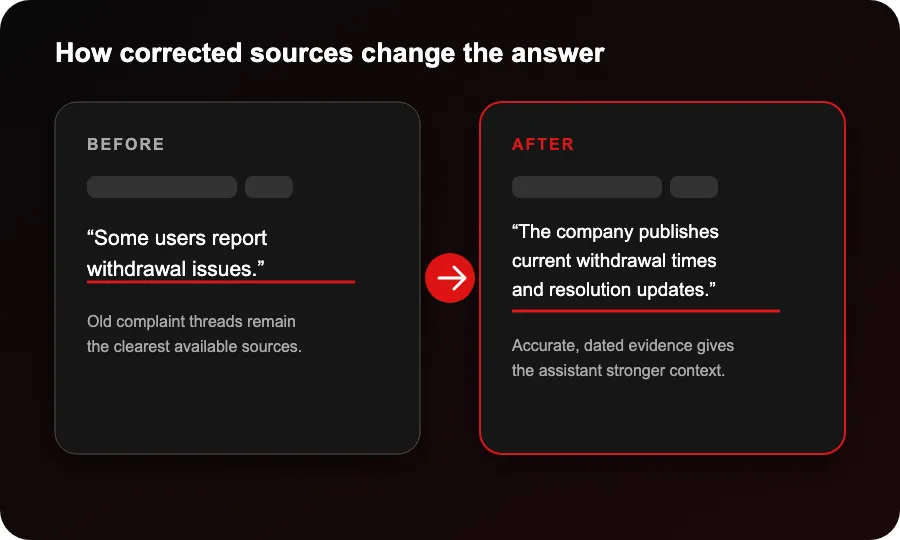
The fix works on the sources, because the answer follows them. Depending on what the audit finds, that means:
- correcting factual errors at the source and, where the source will not correct, publishing the accurate account where models will find it
- resolving the complaint patterns behind the negative sentiment rather than replying to individual posts
- publishing authoritative answer content on your own site for the exact questions buyers ask
- making your entity data consistent across your site, profiles, Organization schema and, where the brand qualifies, Wikipedia
- securing guaranteed press coverage on credible media through digital PR so the model has better sources to prefer.
Corrections start with evidence
Corrections start with evidence. If a licence, executive role, product status or company relationship is wrong, we assemble the authoritative record and correct the pages that created the mistake.
If the problem is a real pattern of complaints, the work begins inside the business: establish what changed, close the affected cases, and publish a dated explanation that future summaries can understand. Reputation copy cannot substitute for an unresolved customer problem.
If AI assistants are already repeating something damaging about you and it is spreading, start with Reputation ER, our emergency response service, and come back to the full program once things are stable.
Owned content and independent coverage
Owned content then fills the gaps. We build direct, well-structured answers for the questions prospects ask, keep core company facts consistent, and connect those answers to the supporting policy, regulatory or service pages.
Secured press coverage on credible third-party media adds independent corroboration where it is appropriate. Together, these sources give assistants a clearer and more current evidence set than the fragmented version they found before.
No promise of removal
What we do not do is promise removal. Legitimate coverage stays where it is; the work is to make sure it is read in context, next to accurate and more recent evidence.
Executives and founders
The same question gets asked about people. Investors, journalists and candidates now ask an assistant who a founder is before they meet them, and the answer is built the same way: from coverage, profiles and whatever else carries the name.
For an executive the fix is the same discipline applied to a person, and the owned assets (LinkedIn, biography pages and speaker profiles) carry more of the weight. See our personal reputation management service and the guide to CEO reputation management.
Identity matching for people
Identity matching matters especially for people. Shared names, old titles and incomplete biographies can cause an assistant to combine two careers or describe a former role as current. We align the executive biography, company leadership page, professional profiles, interviews and credible coverage around the same dates and identifiers.
For founders whose reputation is closely tied to the company, we track the personal and corporate answers together so a correction on one side is not undermined by stale information on the other.
How we measure it
Monthly reruns against the baseline
Monthly, the same buyer questions are rerun under the same conditions and compared with the baseline: mention or not, wording, and sources cited. Citation share per grounding query comes from Bing Webmaster Tools AI Performance, which is the closest thing to a public ledger of which pages the models are reading. Search Console’s generative AI report adds impressions from Google’s AI features.
You see before-and-after answer wording, not a score. The method is the one we published in how to track your brand in AI Overviews and ChatGPT; the reasoning behind it is in how sentiment shapes AI recommendations.
Movement versus noise
Reporting separates movement from noise. One improved answer is useful evidence, but it is not yet a trend. We look for the same corrected fact or fairer wording across several assistants and repeated checks, then confirm whether the cited source set changed.
We record regressions too: a new complaint thread, article or regulatory notice can alter an answer after a period of stability.
Traceable progress
The useful outcome is traceable progress. You can see which questions improved, which claims remain, which sources gained or lost influence, and which actions produced the change. That makes the programme accountable without pretending that an external model can be controlled or that every user will receive identical wording.
Who this is for
Brands whose buyers check before they buy: brokers, fintechs, crypto platforms and other regulated or complaint-heavy niches, where “is it legit” is the first question and the AI answer is the first thing read.
Brands with an active review footprint in several languages, where the sources the models read change weekly. And any company that has already earned a good reputation and wants the machines to say so.
For the financial sector specifically, see reputation management for financial brands.
When it is most useful
It is also useful after a rebrand, acquisition, leadership change, product closure or resolved public incident, when the facts have changed faster than the public web. The service is less useful for a company with no real public footprint and no buyer demand yet; in that case, establishing discoverability and credible authority usually comes first.
FAQ
What is AI reputation management?
AI reputation management is monitoring and correcting how AI assistants describe a brand or a person when asked about them by name. It works on the sources the assistants read (reviews, forums, news, your own pages) so the answer is accurate, current and fair. It is different from generative engine optimization, which is about being recommended for a category.
How do I track brand reputation on AI search engines?
Run the questions your buyers ask about you in fresh conversations across ChatGPT, Gemini, Copilot and Perplexity, and log the answer, its sentiment wording and the sources it cites. Repeat monthly under the same conditions. Bing Webmaster Tools AI Performance adds your citation share per query, and Search Console's generative AI report adds impressions in Google's AI features.
How do I fix brand reputation in AI answers?
Trace each negative or outdated claim to the sources behind it, then fix the sources: correct errors, resolve and publicly close complaint patterns, publish authoritative answers on your own site, keep entity data consistent, and secure press coverage on credible third-party media. Answers follow sources, so they change within weeks once the sources do.
Does having a Wikipedia page help with AI reputation?
When a brand qualifies for one, yes: assistants treat Wikipedia and Wikidata as high-authority sources for who a brand is and what it does. It is not a prerequisite, and most brands do not meet the notability bar. See how AI models use Wikipedia to understand your brand.
Why do AI assistants describe my company negatively?
Because the sources they read say so, or say nothing better. An assistant builds its description from review platforms, forum threads, news and your own pages, and it gives most weight to what is visible and recent. One detailed complaint thread, an old article or an unanswered pattern of reviews is often enough to colour the whole summary. The fix is to find the two or three pages behind the wording and work on them: correct what is wrong, resolve what is real, and publish clear, current evidence the assistant can prefer.
Do you monitor what AI assistants say about a brand on an ongoing basis?
Yes. The same set of buyer questions is rerun every month across ChatGPT, Gemini, Copilot and Perplexity and compared with the baseline, so a change in wording or in the cited sources is caught and traced. When an answer gets worse, we look for the source that caused it, such as a new complaint thread, article or regulatory notice, and act on that source. Monitoring without that second step only tells you that you have a problem.
See how you show up across AI and search
Enter your brand and website to generate an automated Brand Visibility & Reputation Audit. It measures how clearly your brand is understood, discovered, and trusted across search and AI, including sentiment, discoverability, and authority.