What Is a Brand SERP, and How Do You Take Control of Yours?
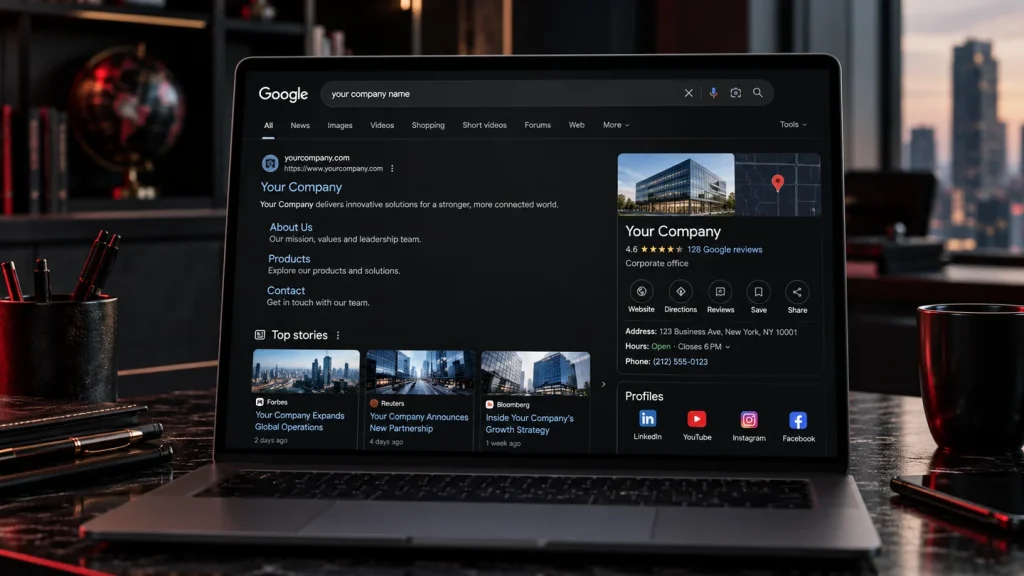
A brand SERP is the page of Google results that appears when someone searches your company name or your own name. It usually holds your website, social profiles, reviews, news, a knowledge panel and an AI Overview. You take control of it in three steps: audit what is there, fix what is wrong at the source, and build pages that deserve the top ten.
This guide covers what appears on that page, where each element comes from, how to audit yours and what to do about each part, including the AI answers at the top.
What Is a Brand SERP?
SERP stands for search engine results page. A brand SERP is the results page for a brand name: your company, your product, or your own name if you are a founder, an executive or anyone whose name people look up before they do business with you.
For a company, it is often the first page a buyer sees after hearing the name. For a person, it is what an investor, a board member or a journalist reads before a first meeting. Either way, it works as a public profile that nobody wrote on purpose.
Branded search is the search itself: someone typing your name, often with a word such as “reviews” or “pricing”. The brand SERP is the result of that search, the page that answers it.
What Shows on Page One When Someone Searches Your Name
Each element on a brand SERP comes from a different source, and you control each one to a different degree. The table lists the usual elements, where Google gets them and how much of each you can change yourself.
| Element | Where Google gets it | How much you control it |
|---|---|---|
| Your website and its sitelinks | Your own pages. Google’s systems analyze your site’s link structure and choose sitelinks automatically | High for the pages. Indirect for sitelinks, which you shape through titles, structure and internal links |
| Knowledge panel | Automated systems drawing on many sources across the web, plus feedback | Partial. The subject or an official representative can claim it and suggest changes |
| AI Overview | A summary Google generates from indexed pages, with links to its sources | Indirect. You change the sources it reads, not the summary |
| Review platforms | Profiles on software review sites, app stores, Trustpilot and employer review sites | Partial. You own the profile and the replies, customers write the reviews |
| News | Articles from publications Google indexes as news | Low to medium. Announcements and press coverage add new stories |
| Social and professional profiles | Company accounts on LinkedIn, X and YouTube, plus your executives’ profiles | High. You create and maintain them |
| People Also Ask | Questions Google relates to the search, answered from indexed pages | Indirect. A page that answers the question well can become the source |
| Autocomplete | Predictions Google shows as the name is typed | None directly |
| Images and videos | Images and videos on indexed pages, including your site and your video channels | Medium. You publish your own, with descriptive file names and alt text |
The more of page one that comes from sources you own or influence, the less of it is left to chance. The elements you cannot edit, the knowledge panel and the AI Overview above all, follow the sources beneath them.
Company Brand SERPs and Personal Brand SERPs
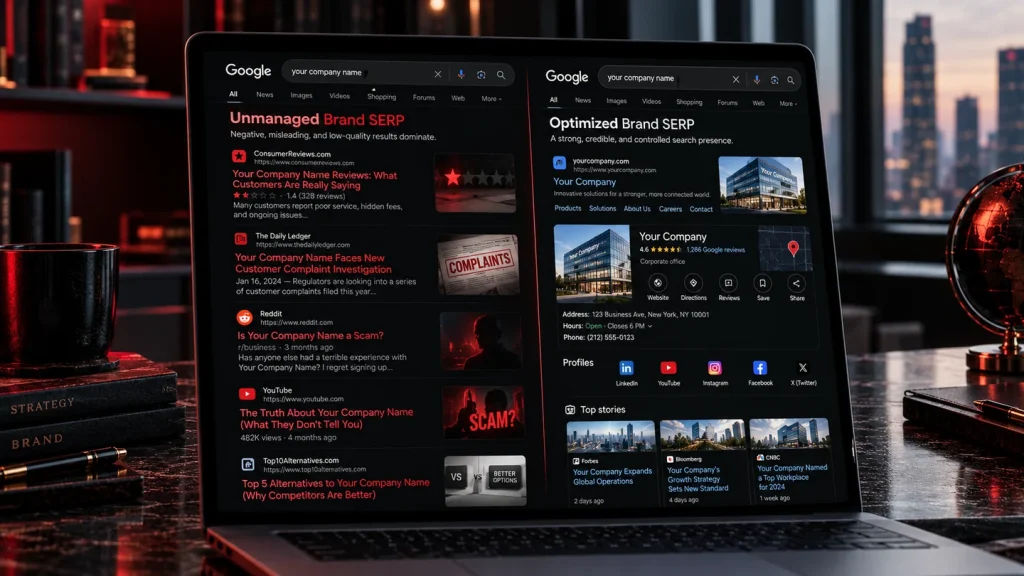
A company’s brand SERP is built mostly from its own site, its review profiles, news coverage and official records such as business registries and regulatory listings. For a fintech app, the regulator’s register entry and the app store rating often sit on page one next to the homepage.
A personal brand SERP is built from different material: LinkedIn and other profiles, interviews, conference pages, podcast episodes and old articles. A founder who shares a name with someone else may find that part of page one belongs to the namesake, which confuses anyone checking them before a meeting.
The method is the same for both. Audit what is there, fix what is wrong at the source, and build pages that deserve to rank. Only the sources change, and with them the order of the work.
Branded Search: Why the People Who Search Your Name Matter Most
People rarely search a company name by accident. Someone searching your name usually knows you exist and is deciding something: whether to sign a contract, renew a subscription, invest, accept a job offer or quote you in a story.
That makes the brand SERP the page that sets the first impression for the people closest to a decision. A buyer late in a software evaluation searches the vendor’s name with “reviews”. A candidate searches the employer. An investor searches the founder.
A SaaS company whose page one shows a two-year-old outage thread is making its case to every one of those people with the outage, long after it was fixed. The thread ranks because nothing newer and stronger answers the same search.
In paid search, branded search also names a metric: how many people search for your brand, used to judge advertising and awareness. For your reputation, what matters is what those searchers find.
How to Audit Your Brand SERP
An audit is a dated record of what people see when they search your name. Do it before you change anything, so you can later measure what moved. The steps work for a company and for a person.
- Open a private browser window, so your own history and signed-in account do not shape the results.
- Search the exact name, then its variants: the short form, the legal name, common misspellings and, for a person, the name with the company.
- Add “reviews”, “complaints” and “scam” to the name, one at a time. These are the searches buyers run before they commit.
- Read the first two pages, not only the first. A negative result on page two can reach page one with a single update.
- Note the AI Overview and the knowledge panel: what they say, which sources they link and whether the facts are current.
- Ask two or three AI assistants, such as ChatGPT, Gemini and Copilot, what they know about the company or the person.
- Save everything with the date: screenshots, plus a list of each result, its source and whether it helps, harms or is neutral.
- Repeat for each country and language that matters to you. Results for the same name differ by market.
A professional online reputation audit adds sentiment per result, the sources behind AI answers and a priority list. Once the baseline exists, online reputation monitoring tells you when something new reaches page one.
How to Take Control of Your Brand SERP
You change a brand SERP by changing the sources it draws on. Work through them in this order, starting with what you own outright.
Your own site first
Your website should hold the top result for your name, with sitelinks beneath it. Google’s guidance on sitelinks says they are automated: Google analyzes the site’s link structure, and owners cannot set them. To remove one, you delete the page or mark it noindex.
What you can do is make the structure easy to read. The same guidance recommends informative, concise page titles and headings, a logical structure that links important pages from related pages, and short internal anchor text that describes the destination. A clear About page, product pages and a pricing page are the usual candidates.
The knowledge panel
Google says knowledge panels are generated automatically from sources across the web. The subject or an official representative can claim a panel and suggest changes, and anyone can send feedback from the panel itself. For the steps, see how to get, claim and edit your Google Knowledge Panel.
Profiles that rank for names like yours
Search for two or three companies or people similar to you and note which profile sites rank for their names: LinkedIn, Crunchbase, YouTube, GitHub for a software company, conference speaker pages for an executive. Then create or complete those profiles for your own name.
Consistency matters as much as presence. The same company description, leadership names, founding year and website on every profile make it easier for search engines and AI assistants to connect them to one company or one person.
Reviews, within each platform’s rules
Review profiles rank for brand searches, and for the name with “reviews” they often take the top results. Claim your profile on the platforms your buyers use, ask every customer for a review in the way each platform allows, and reply to reviews, negative ones included, with facts and a route to support.
A fintech app that finds a complaints page ranking for its name with “reviews” has one lasting answer: more recent reviews from real customers, collected within each platform’s rules, on the profiles buyers trust. Report a review only when it breaks the platform’s own rules.
Press coverage that names you
News results and many People Also Ask answers come from publications. Coverage that names your company or your founder in outlets your buyers read adds strong, independent results to page one and gives AI answers a current source. Digital PR with guaranteed press coverage places that coverage in named outlets on a known schedule.
When a negative result is on page one
Some results need more than new pages. If a result shows a person’s phone number, home address or email, Google’s Results about you tool lets them request its removal from Google Search, while the page stays online. Content that breaks a site’s rules or the law can be reported. For lawful results that stay, our guide on how to push down negative search results explains what works.
Your Brand SERP and AI Answers
AI Overviews and assistants such as ChatGPT, Gemini, Copilot and Perplexity answer questions about your company from sources they find on the web, many of them the same pages that rank on your brand SERP. An outage thread on page one can become a line in the AI answer.
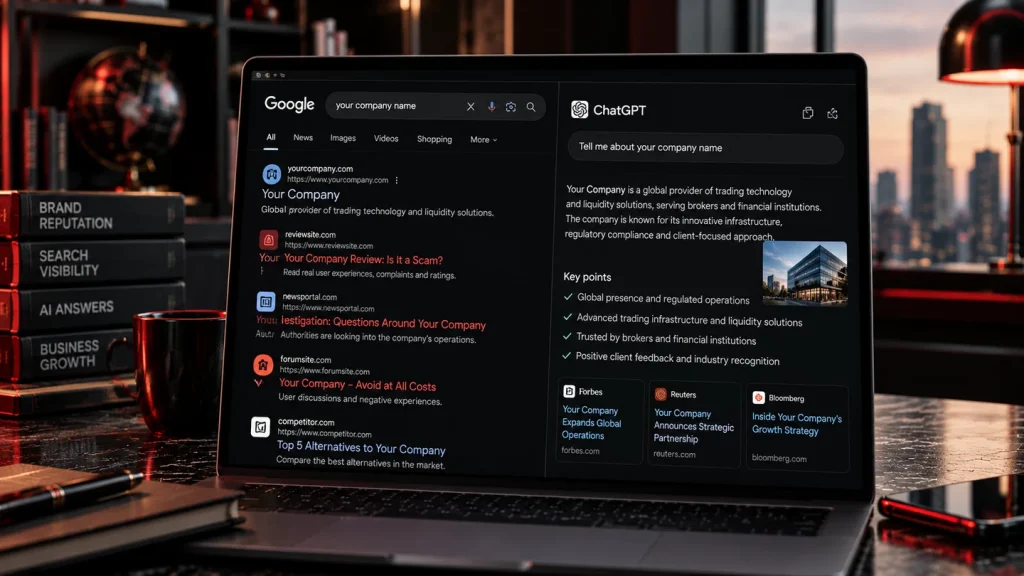
That is why a clean page one and an accurate AI answer are built from the same record. When the sources are current and consistent, both improve together. When an old or wrong page dominates, both repeat it.
AI answers add one step to the work: ask what the assistants say, check which sources they cite, and correct the record at those sources. Correcting what assistants say about a company or a person is the work of AI reputation management. It also shapes your wider brand reputation, because buyers now read both.
When to Bring in Help, and What It Costs
Most of the audit, the profiles and the site work above can be done in-house. Help makes sense when a negative result holds its position for months, when the problem spans several languages or platforms, or when AI answers already repeat it.
Professional programs are priced monthly. These are the ranges in our guide to what online reputation management costs:
- $1,000 to $3,000 a month for a light cleanup: a few weak negative results in one language, typically 3 to 6 months.
- $3,000 to $10,000 a month for a standard suppression program: persistent negatives across several platforms, typically 6 to 12 months.
- $10,000 a month and up for regulated or high-profile repair: news coverage, several languages or AI answers already affected, typically 9 to 18 months.
For a company, see online reputation management services for companies. For founders and executives, personal reputation management covers the name. When results on page one are already doing damage, online reputation repair is where the work starts.
Want to know what page one and AI answers say about your company or your name today? Start with an online reputation audit, or talk to us about what to fix first.
Brand SERP FAQ
What is a brand SERP?
A brand SERP is the search engine results page that appears when someone searches a company name, a product name or a person’s name. It usually includes the official website with sitelinks, social and professional profiles, review platforms, news, a knowledge panel, People Also Ask questions and often an AI Overview. It works as the first impression for anyone checking you.
What is branded search?
Branded search is a search that includes a brand name, such as a company, a product or a person, often with words like “reviews”, “pricing” or “login”. In paid search it is also a metric for how many people search your brand. For reputation, the useful question is what those searchers find on the results page.
What is brand SERP optimization?
Brand SERP optimization is the work of making the results page for your name accurate and helpful. It covers your own site’s titles and structure, complete and consistent profiles, review profiles managed within each platform’s rules, press coverage that names you, the knowledge panel and the sources AI answers read. It starts with a dated audit of what ranks today.
How do I change what shows up when I Google my company?
Change the sources, because the results page itself cannot be edited. Audit the first two pages in a private window, correct wrong facts on the pages you own, complete the profiles that rank for names like yours, collect reviews within each platform’s rules and add press coverage that names the company. Strong, current pages gradually take the top positions from weaker or outdated ones.
Can I remove a result from my brand SERP?
Sometimes. Google removes results that break its policies or the law, and Results about you handles pages showing a person’s phone number, home address or email, removing them from Google Search only. A publisher can correct or update its own page. Lawful, accurate results stay in the index, and the route for those is to push down negative search results with stronger pages.
How long does it take to improve a brand SERP?
Changes to pages you own show once Google recrawls them, which can take days or weeks. New profiles and press coverage take longer to settle on page one. Pushing down a persistent negative result typically takes 3 to 6 months for a light cleanup, 6 to 12 months for a standard program and 9 to 18 months for a high-profile case.