What Is Brand Reputation? How to Build, Measure and Protect It

Brand reputation is what people believe about a company, based on what it does and what others say about it. Brand image is what the company projects. Reputation is what customers, partners, journalists and now AI assistants conclude. You build it by delivering consistently, making that visible in search results, reviews and press coverage, and correcting what is wrong at the source.
This guide explains how brand reputation differs from the terms around it, where it forms today, how to measure it without invented scores, and what to do to build it, protect it and repair it when something goes wrong.
What Is Brand Reputation?
Brand reputation is the shared judgment people hold about a company: whether it delivers, whether it treats customers fairly, whether it can be trusted with money, data or a contract. It forms from experience first, and then from what others say and what anyone can find.
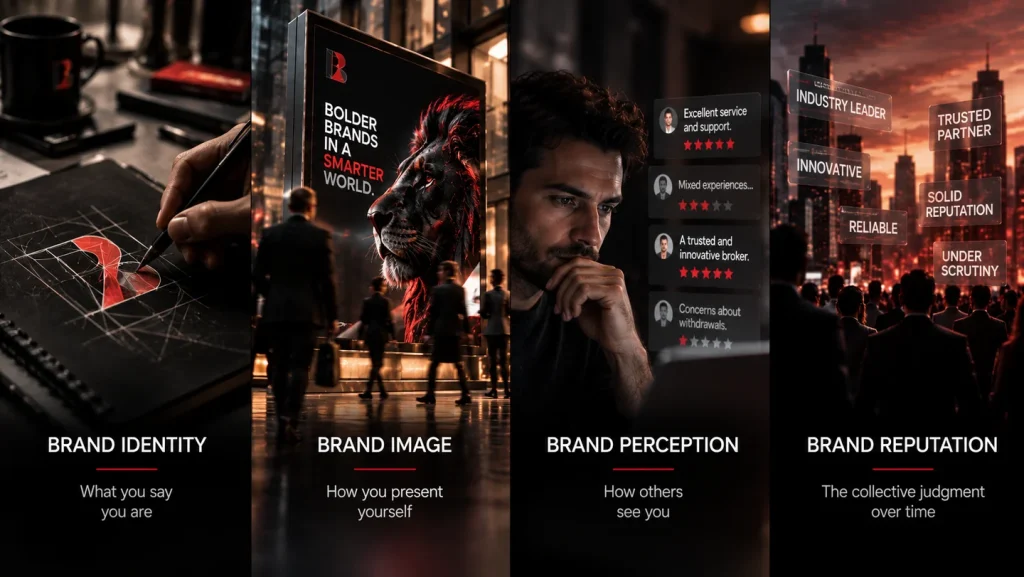
It is often confused with three nearby terms. The table separates them by what each one is, who shapes it and how long it takes to change.
| Term | What it is | Who shapes it | How long it takes to change |
|---|---|---|---|
| Brand identity | The name, logo, voice and promise a company defines for itself | The company | Fast. The company can change it whenever it decides |
| Brand image | The impression the company projects through its marketing, website and messaging | The company, through what it communicates | Months. It follows campaigns and messaging |
| Brand perception | How one customer sees the brand at a given moment, often after a single interaction | Each customer, from their own experience | Can shift with one experience, good or bad |
| Brand reputation | The lasting judgment that customers, partners, journalists and AI assistants reach about the company | Everyone who deals with the company or writes about it | Slow. Months to years, as behavior and the public record change |
The first two belong to the company. The last two belong to everyone else. A person’s name works the same way: a founder or an executive has a reputation formed from the same kind of record, and it often travels with the company’s.
Why Brand Reputation Matters for Online Businesses
An online service is usually chosen before anyone talks to the company. The buyer reads what can be found, decides whether the company is worth a call, and rarely says why the call never happened.
A SaaS buyer shortlisting vendors searches each name and finds an outage thread from two years ago. A fintech customer reads withdrawal complaints before depositing. An iGaming player checks licensing questions before signing up. A law or consulting firm is checked by the client’s procurement team before any proposal is read.
Customers are only part of the audience. Partners check the record before an integration, investors before a term sheet, candidates before an interview, and regulators when a complaint arrives. Each of them reaches a conclusion without asking the company first.
For an online business, then, reputation lives in what can be found. A strong product with a weak public record loses to a rival whose record answers the buyer’s questions.
Where Brand Reputation Is Formed Today
Reputation still starts with what the company does. What people learn about it, they learn mostly in the places below, and each one feeds the others.
Search results for your name
The first page of results for a company name works as its public profile: the website, review platforms, news, profiles and often an AI Overview. Our guide to the brand SERP explains what appears there and how to take control of it.
Reviews and ratings
Reviews are where customers speak in their own words, and they rank for the company name with “reviews”. Three habits hold on every platform: ask every customer for a review in the way the platform allows, reply to every review with facts and a route to support, and report only reviews that break the platform’s rules.
Replies are read by the next buyer more than by the reviewer. A calm, specific reply to a complaint about a renewal charge or a slow support ticket shows how the company behaves when something goes wrong.
News and press coverage
Coverage in publications a buyer recognizes adds independent judgment to the record, and news results often sit on page one for a company name. Digital PR with guaranteed press coverage places the company in named outlets on a known schedule, so the record carries current, accurate stories alongside the old ones.
Social platforms and communities
Reddit threads, LinkedIn posts and sector forums are where customers compare notes, often in more detail than in reviews. These threads rank in search, and assistants read them. A company that answers questions openly in those places, under named people, adds its side to the record.
AI assistants and AI Overviews
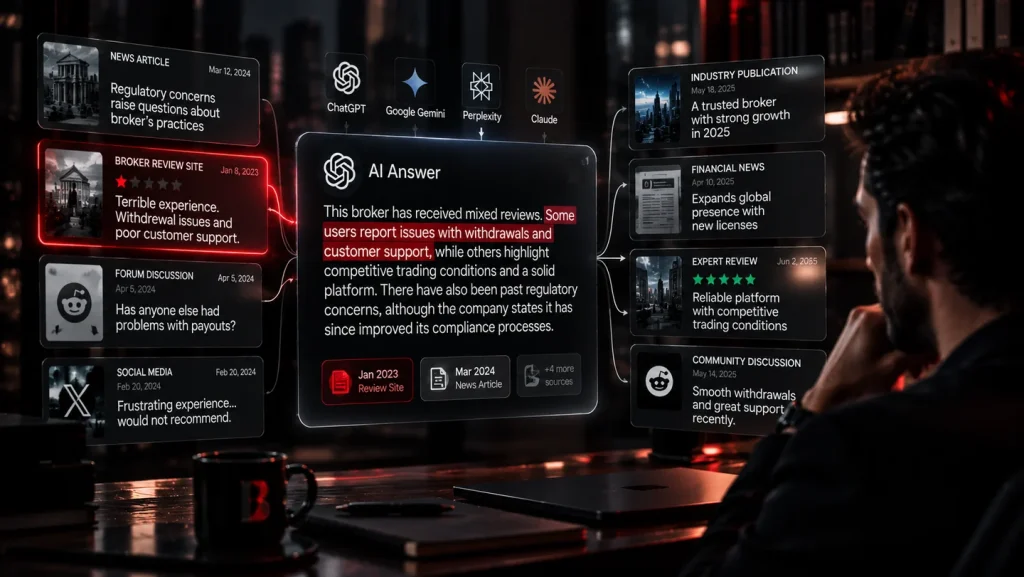
ChatGPT, Gemini, Copilot, Perplexity and Google’s AI Overviews summarize the same sources: search results, reviews, coverage and community threads. An old complaint that still ranks can become the answer a buyer reads first. Checking and correcting what assistants say about a company is the work of AI reputation management.
How to Measure Brand Reputation
Reputation has no single number. Measure the signals it is made of, record them with the date, and compare the same signals every month, in every market and language that matters to you.
- Sentiment of page one for the name. How many results on the first two pages help, harm or are neutral.
- Review ratings and their trend. The average on each platform that matters, the number of recent reviews and the direction over the last six months.
- Share of press coverage. How often the company appears in the outlets its buyers read, compared with others in the category.
- What two or three AI assistants say. The description, the facts, the tone and the sources each one cites.
- AI share of voice. How often assistants name the company when asked about the category, against the companies a buyer would compare.
The first full reading of these signals is an online reputation audit. After that, online reputation monitoring repeats it and alerts you when something new appears, and AI share of voice tracks how often assistants name you on category questions. For a first look at what assistants say, request an AI visibility report.
How to Build Brand Reputation
A brand reputation strategy is a short list of habits kept up for years. These six cover most of what builds and improves the reputation of an online business.
- Deliver, and fix what customers complain about. Read support tickets, cancellation reasons and reviews for the complaint that repeats. A billing surprise or a slow withdrawal fixed at the source removes the cause of future complaints.
- Keep facts consistent on every profile and directory. Name, description, leadership, address, website and founding year should match on your site, LinkedIn, review profiles, app stores and business directories.
- Ask every customer for a review, within each platform’s rules. Ask at a natural moment, such as after onboarding or a resolved ticket, and offer nothing in return where the platform forbids it.
- Get third-party press coverage that names the company. Independent stories in outlets your buyers read carry more weight than anything the company says about itself.
- Give named people a visible voice. Founders and executives who write, speak and answer questions in public give the company a face buyers can check. Their own search results become part of the brand’s record.
- Publish pages that answer what buyers ask. Pricing, security, onboarding, how support works and who runs the company. Add structured data, so search engines and AI assistants read the facts correctly.
None of the six is a one-off campaign. They are what the company does every week, and the record follows.
How to Protect and Repair a Damaged Brand Reputation
Damage usually starts with one item: a viral post, a critical article, a wave of complaints after an outage. What the company does in the first days decides how far it travels.
Respond fast, without making it bigger
Reply where the problem appeared, once, with facts and what you are doing about it. Avoid threats, takedown demands and public arguments. A loud attempt to bury a story tends to spread it further, the pattern known as the Streisand effect.
Fix the cause, then the record
If an outage, a billing error or a support failure caused the damage, fix it first and say so. Then correct the record: update the help center, reply to the reviews, ask publishers to update facts that are now wrong, and publish a dated account of what changed.
Remove, suppress, rebuild
An owner may ask for content to be removed when it breaks a platform’s rules or the law, through the platform or with legal advice. Most negative content is lawful and stays. That content is pushed down by building stronger, accurate pages that outrank it. This sequence is the core of online reputation repair.
When it is a crisis
When damage spreads by the hour, through news coverage, a viral thread or AI answers repeating a fresh accusation, treat it as a crisis: one owner, one statement and a fast triage of what is spreading where. A reputation emergency needs that triage within days.
Brand Reputation Management: When to Bring in Help
Brand reputation management is the ongoing program that keeps the record accurate: monitoring, review work within each platform’s rules, profiles and content, press coverage, and the sources AI assistants read. Many companies run the basics in-house and bring in help when a problem outlasts their own efforts.
Help makes sense when a negative result or an AI answer holds for months, when the problem spans languages or platforms, or when a regulator, an investor or a major client is reading. Programs are priced monthly, as set out in our guide to what online reputation management costs:
- $1,000 to $3,000 a month for a light cleanup: a few weak negative results in one language, typically 3 to 6 months.
- $3,000 to $10,000 a month for a standard suppression program: persistent negatives across several platforms, typically 6 to 12 months.
- $10,000 a month and up for regulated or high-profile repair: news coverage, several languages or AI answers already affected, typically 9 to 18 months.
For companies, see online reputation management services for companies. For founders and executives whose names carry the brand, see personal reputation management.
Want to know what search results, reviews, press coverage and AI assistants say about your company today? Start with an online reputation audit, or talk to us about where your brand reputation needs work.
Brand Reputation FAQ
What is brand reputation?
Brand reputation is what customers, partners, journalists and AI assistants believe about a company, based on what it does and what others say about it. It forms from experience, reviews, search results, press coverage and community discussion. It differs from brand image, which is what the company projects, because reputation is the conclusion other people reach.
Why is brand reputation important?
Buyers of online services decide before they talk to anyone. A SaaS buyer reads reviews and outage threads, a fintech customer checks complaints, and a client’s procurement team checks a consulting firm’s record. Partners, investors, candidates and regulators read the same record. A weak reputation loses deals the company never hears about.
What is the difference between brand image and brand reputation?
Brand image is the impression a company projects through its marketing, website and messaging, and the company controls it. Brand reputation is the judgment others reach from experience, reviews, coverage and search results, and the company can only influence it. Image can change with a campaign. Reputation changes slowly, as behavior and the public record change.
How do you build brand reputation?
Deliver consistently and fix what customers complain about. Keep facts identical on every profile, ask every customer for a review within each platform’s rules, get third-party press coverage that names the company, give founders and executives a visible voice, and publish pages that answer buyers’ questions, with structured data. Keep doing it every month.
How do you measure brand reputation?
Measure the signals it is made of: the sentiment of the first two pages of results for your name, review ratings and their trend, your share of press coverage in the outlets buyers read, what two or three AI assistants say about you, and how often assistants name you on category questions. Record them with the date and compare monthly.
How do you fix a damaged brand reputation?
Fix the cause first, then correct the record at its sources. Report or request removal only of content that breaks a platform’s rules or the law. Push down what stays by building stronger, accurate pages that outrank it, and keep reviews, coverage and profiles current. These steps, in that order, are the method of online reputation repair.