
How Long Should a Press Release Be? The Ideal Length, Section by Section
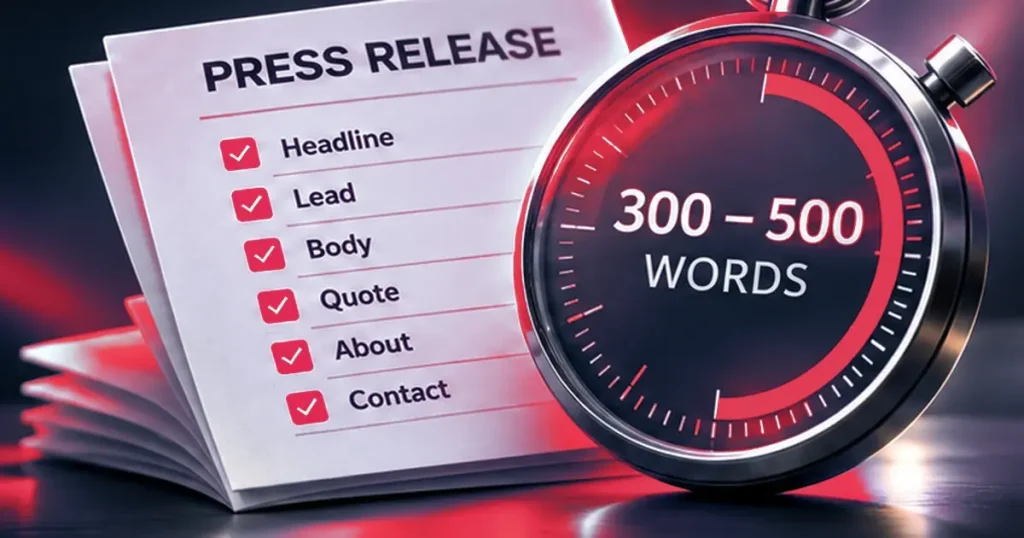
A press release should be 300 to 500 words, about one page. The headline stays under 100 characters, the first paragraph tells the whole story in one or two sentences, the body runs two to four short paragraphs with one quote, and the boilerplate takes 50 to 100 words. Go longer only when the news needs figures.
That range aligns with published guidance from major press-release distributors, and it has held for a long time for a simple reason. A release is written to be used by someone else: published as it is, quoted, or summarized. The shorter and clearer it is, the more of it survives.
How long a press release should be: the short answer
Aim for about 400 words and treat 500 as the ceiling for ordinary company news. A short announcement, such as an appointment or an event, can be complete in 200 to 300 words.
Count the words, then read only the headline and the first paragraph. If those two alone tell a stranger what happened, the length is working. If the news only appears in paragraph three, the release is too long whatever its word count.
Press release length by section
| Section | Length | What it has to do |
|---|---|---|
| Headline | Under 100 characters, with the main point in the first 65 | Say what happened. Search results cut long headlines |
| Subheadline (optional) | One line, up to about 20 words | Add the one fact the headline had no room for |
| First paragraph | One or two sentences | Who, what, when, where and why it matters |
| Body | Two to four paragraphs of two or three sentences each | The detail, the context and one quote |
| Quote | Two sentences | A point of view the facts do not already give |
| Boilerplate | 50 to 100 words | The standard About paragraph |
| Contact | Two or three lines | A name, an email and a phone number or press page |
The boilerplate is the one section that should never change length from release to release. Our guide to the press release boilerplate explains what goes in it.
Why short releases are easier to use
Editors. An editor decides in the headline and the first paragraph. A release that needs little editing is easier to work with.
Partners and customers. They read the release on your newsroom or in their inbox. A concise release is easier to read in full; a long one may be skimmed for the one line that concerns the reader.
AI assistants and search. They may extract or summarize passages. A short paragraph that states one fact clearly is easier to interpret. A long one that mixes several facts with marketing language makes an accurate summary harder. For how a release is written to be found, see our guide to the SEO press release.
Length also has a practical side: many distribution options are priced for a standard length and charge more beyond it. Our guide to what distribution costs covers how that works.
When a longer release is fine
Some news cannot be told in 400 words without leaving out what readers need:
- Financial results, where tables and required statements are part of the announcement.
- Research and data releases, where the method and the main figures have to be stated.
- Regulated announcements, where a license, a ruling or a disclosure carries mandatory wording.
- A release about two companies, where each needs its own quote and boilerplate.
Even then, the first 150 words should communicate the essential news without depending on what follows. Everything after them is reference material for the reader who wants it.
What to cut first when it runs over
- The second and third quotes. Keep the one that says something.
- Adjectives and claims. “Leading”, “innovative” and “world-class” add words and no information.
- Background the boilerplate already covers. The company description belongs at the end, once.
- The feature list. Name the two or three things that are new and link to the page that has the rest.
- The history. How the project started is a story for an article, and the release can point to it.
What stays is the news, the reason it matters, one voice and the facts someone needs to act on it.
Length is one release. Coverage is the campaign
Getting the length right makes a release usable, and a usable release is still one release. In a digital PR campaign the release is the first stage: it puts the facts on record in a form that can be published as it is. The stages after it, articles on named publications and wider coverage, are where the detail that did not fit in 400 words gets its space.
So the question behind “how long” is usually what to do with everything that was cut. The answer is to keep the release short and give the rest of the story its own places to be published.
Planning an announcement? We run digital PR campaigns with guaranteed press coverage, from the release to the follow-up articles.
Tell us what you want to achieve
Share a few details about your goals and current challenges. Our team will review them and get back to you with the most useful next step.
Start a conversation.
Press release length: FAQ
How long should a press release be?
A press release should be 300 to 500 words, which is about one page. That gives room for a headline, a first paragraph with the whole story, two to four short body paragraphs with one quote, the boilerplate and a contact. Short announcements can be complete in 200 to 300 words.
How many words should a press release be?
Aim for about 400 words and treat 500 as the upper limit for ordinary company news. Financial results, research findings and regulated announcements can run longer because tables or required wording are part of the news, but their first 150 words should still work as a complete short release.
Can a press release be two pages?
Yes, when the news needs it: financial results, data releases, regulated disclosures or an announcement by two companies. For ordinary company news a second page usually means extra quotes, background or a feature list that belongs on a web page the release can link to.
How long should a press release headline be?
Keep the headline under 100 characters and put the main point in the first 65, because search results and many news sites cut longer headlines. It should say what happened in plain words. If more context is needed, add a one-line subheadline of up to about 20 words.
How long should the quote in a press release be?
Two sentences from one named person is enough. The quote is the only place in a release for a point of view, so it should say why the news matters, in words the facts above it do not already use. Add a second quote only when another party is part of the news.
Does press release length matter for AI answers?
It matters because of how the text is used. When AI assistants use web sources, they may quote or summarize parts of a release. Short, self-contained paragraphs that each state one fact reduce ambiguity compared with long paragraphs that mix facts with marketing language.