
How to Remove Unwanted Google Search Results (and What to Do When You Can’t)
There are three ways to remove an unwanted result from Google: get the content taken down at the source, get Google to remove it from search through tools like Results About You, the outdated content tool or a legal request, or, when neither is possible, suppress it by outranking it with content you control. Which route applies depends on what the content is, who published it, and whether it breaks a platform rule or a law. Here is how to tell, in order of what to try first.
Picture this: You go into a meeting with a potential partner, a job interview or even a date, with the uncomfortable sinking feeling that the other side has already Googled you, which they probably did if they are human (and you know what they saw). You conduct the meeting with a sense of being on the backfoot and in an attempt to win them over, you try too hard to impress them. Talk about starting off on the wrong foot. Choose the route carefully: a clumsy removal attempt can trigger the Streisand effect.
It is extremely embarrassing that your dirty laundry is there for all to see and, when we talk about prominence on Google search, also sadly very hard to avoid. At some point or another, someone might come after you. The good news is that a lot more is removable than most people assume, and where removal is off the table there is still a route that works.
| What the unwanted result is | Best route | Realistic outcome |
|---|---|---|
| Content you or your company published | Edit or delete at the source, then request recrawl | Fast, days to weeks |
| Your personal data (address, phone, ID numbers) | Google Results About You tool + source takedown | Good odds, days to weeks |
| Outdated page that no longer exists or has changed | Google outdated content tool | Good odds, days |
| Defamatory, infringing or unlawful content | Legal request to the platform and to Google | Case-dependent, weeks to months |
| Fair negative review, accurate news, opinion threads | Suppression: outrank it, do not chase removal | 3 to 12 months, the standard professional route |
Step 1: Remove or fix the results you control
We’ve all been in that situation. We post something on Facebook without thinking twice. We Tweet and then notice an embarrassing typo only 2 weeks later. We write an angry review on Yelp, only to sleep it over and to decide that we went too far with the criticism.
The great thing about this ‘spur of the moment’ content is that there is (usually) a delete button. However, this doesn’t solve all your problems, since often that content has already found its way to Google search. Don’t worry, though, because you can remove non-existing or outdated content, by approaching Google directly.
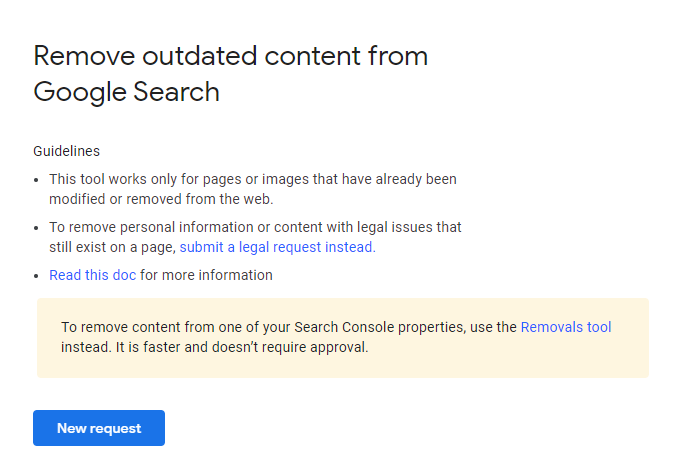
This process is straightforward and simple, but note that you can only use this option if the content you want to remove doesn’t load. If you deleted it from the internet, that shouldn’t be a problem, though. But what about responses or talkbacks that you received for the content? Do they get removed too? That’s a bit more tricky. Read on to understand.
Step 2: Clean up social media results
It’s crazy how many times social media, especially Twitter, comes back to bite people who then become celebrities overnight for all the wrong reasons. What’s even crazier is how fast these mean talkbacks and comments gain traction – and even dominance on Google search results.

Source: https://pixabay.com/illustrations/social-media-manager-online-1958774/
If you think you’ve posted anything you shouldn’t have, delete it before it becomes a bigger issue. True, this is not an airtight solution, since some social media networks keep the feedback alive even after you’ve deleted your original content. However, without access to your original text, image or video, the context is also gone from the responses – and these “contextless” bits and pieces tend to disappear faster from Google searches.
Step 3: Ask Google to remove personal data (Results About You)
Maybe you haven’t done anything wrong, you just don’t want your phone number and/or address online for the whole world to see. Totally legitimate. The problem is that some websites scrape from all kinds of places and display it anyway. Google, not knowing whether your details were obtained consensually or not, most often just goes along, assuming that if it is a problem, you will take measures to remove it.
Well, you can. First of all we recommend contacting the specific website which published your details and asking for them to be removed. If that doesn’t work, though, you can always contact Google and flag this information as personal and published without consent. Google’s Results About You tool handles exactly this class of request. While Google tries to be prompt in its responses, this process can take a few days.
Step 4: Get outdated or inaccurate pages refreshed or removed
In terms of inaccurate and not up-to-date results, the process is pretty much the same. It could be that your brand’s address or phone number is listed as an old one, it could even be that you’re no longer a bachelor/bachelorette and you want the world to know, it could be that your company has a new CEO (or that you’re a new CEO of a company – congrats, if that is the case).
Once again, start off by contacting the website where the inaccurate information appears. If it is not updated, the website will probably have no issue making changes. Contact Google only if you see that your efforts are not bearing fruit.
Step 5: Legal removal requests: defamation, copyright, privacy law
This is where it gets a bit complicated. Sometimes you can legally require content to be removed from Google, and it doesn’t matter who is in violation (the website that published the content or Google for displaying it). If this bad information is used to blackmail you, for example, you have grounds to report the negative result to Google and they will remove it for you. This is a gross violation of their terms and conditions.
There are several laws and regulations put in place to determine what is illegally displayed on Google, when, where and in what context. However, each country additionally has its own set of restrictions and Google must abide by them, so it is important to realize what arena you are playing in, and what the rules of the game are.
For example, a DMCA request can be made to Google when you believe that your copyright has been violated in some form. In Europe, the right to be forgotten is a tool that can assist you in removing all types of content. However, since this is an official legal progress, we advise that you check all the legal requirements to make sure you fulfill the criteria required for a successful claim. Otherwise, you might end up not only with your request denied, but also with a financial loss (not to mention the time wasted).
Why Google says “some results may have been removed”
If you search a person’s name from Europe, Google often ends the results page with the line “Some results may have been removed under data protection law in Europe”. It does not mean anything about you was removed. Google shows the notice on most name searches in EU and UK results whenever a query looks like a person’s name, whether or not a request was ever filed. It is a legal disclosure, not a signal.
The other notice you may see is different: “In response to a complaint we received under the US Digital Millennium Copyright Act, we have removed N result(s) from this page.” That one is specific. Someone filed a copyright complaint about a result that used to appear for this query, and Google delisted it. The complaint itself is usually published in the Lumen database, which the notice links to, so you can read who filed it and which URL was removed.
For a brand or an individual the practical reading is this: the European notice tells you nothing and needs no action; the DMCA notice tells you a takedown has already happened on this query, and the Lumen record shows whether it was yours, a competitor’s, or a copyright holder’s. Neither notice removes a result you are still seeing. For those, the routes are the five steps above and, when none applies, suppression.
When Removal Is Impossible: Suppression
Plenty of unwanted results break no rule and no law: a fair negative review, an accurate news story, a forum thread full of opinions. Google will not remove those, and pretending otherwise is how people waste months. The working alternative is suppression: building and strengthening pages that outrank the unwanted result for the searches that matter, until it slides off the first page, where clicks effectively end. Suppression is slower than removal, typically 3 to 12 months depending on the authority of the unwanted result, and it is the standard professional route for negative press and reviews. It also has a second effect that matters in 2026: AI assistants summarize the strongest sources they find, so rebalancing page one also changes what ChatGPT, Copilot and Gemini say when someone asks about you.
For the full method, see our guide to search engine suppression and how to bury a result that cannot be removed.
There are other ways to remove information from Google, and each case should be assessed separately. This is just the tip of the iceberg. Also, there is no 100% success guarantee here. If unwanted results about you still appear prominently in search, then what you need is online reputation management (ORM). As professionals in the field, we can tell you that there is a chance that you won’t be able to completely remove a search result. However, ORM experts do have the tools and know-how to shove it down and out of the first page of Google search and, between us, who even goes beyond that?
Keep monitoring: Google and AI answers
You need to spot the problem before solving it, and you need to keep spotting it after. How often do you Google yourself or your brand’s name? Do you try different combinations of keywords, and check various geolocations (according to your target audience)? Are you aware of the feedback you are receiving on your social media pages? Do you get to check Google News every once in a while as well? Ask ChatGPT, Copilot and Gemini about yourself too, because that is increasingly where the first impression is formed.
Only via a thorough investigation will you find the soft spots that require your attention.
Want to know more about search result removal? Curious about what ORM can do for you? Contact us at Buzz Dealer. We can have a chat, assess your situation and see what we are able to do for you.
Frequently Asked Questions
Can you remove a Google search result you don’t own?
Sometimes. If it exposes personal data, is outdated, or breaks a platform rule or a law, removal at the source or through Google’s tools is realistic. If it is a fair review or accurate reporting, no; the working route is suppression, outranking it with stronger pages. For reviews specifically, see our guides to Google review removal and Glassdoor review removal for employers.
How do I remove my personal information from Google?
Use Google’s Results About You tool to request removal of results exposing your address, phone number or ID details, and ask the source site to delete the page itself so it does not resurface elsewhere.
Can negative news articles be removed from Google?
Rarely. Accurate reporting is not removable, and heavy-handed attempts tend to backfire. Defamatory or unlawful articles can be challenged legally; for everything else, suppression and rebalancing of the search results is the realistic strategy. The full route-by-route guide is here: how to remove a news article from Google.
How much does it cost to remove or suppress a search result?
Source removals and Google tool requests cost nothing but time. Professional suppression programs typically run $1,000 to $10,000 per month for 6 to 12 months depending on the authority of the unwanted result; see our full breakdown of what reputation repair costs.
How long does it take Google to remove a result?
Tool-based removals usually resolve in days to a few weeks. Legal requests take weeks to months. Suppression of non-removable results takes 3 to 12 months of sustained work.
Does removing a result from Google delete the page?
No. Google removal only takes the page out of search results; the page still exists and can be found directly or cited by AI assistants. That is why source takedown, where possible, always beats search-only removal.
What does “some results may have been removed” mean on Google?
The European version of the notice is a standard disclosure Google adds to most name searches in the EU and UK; it does not mean a result about you was removed. The DMCA version means a specific result was delisted after a copyright complaint, and the linked Lumen record shows which URL and who filed it.