What Is a Press Kit, and What Should You Put in It?
A press kit is a single page, usually on your own website, that holds the facts anyone covering your company needs without having to ask: a short company description, key facts, leadership bios and photos, logos, recent announcements and one press contact. Editors use it to get the details right, and AI assistants read it for the same reason.
What a press kit is, and who reads it now
The press kit started as a folder handed out at launches and trade shows. Today it is a page on the company site, usually at an address such as /press/ or /newsroom/, with the files people need to download. The goal has not changed: make the accurate version of your company the easiest one to copy.
The readers have changed. Journalists still use it, but so do event organizers writing speaker pages, partners preparing a joint announcement, analysts, investors, candidates and podcast hosts. And so do AI assistants: when someone asks ChatGPT or Gemini about your company, the answer is built from pages like this one.
A press kit works next to your press releases, not instead of them. A release announces one piece of news on one date. The press kit holds the facts that stay true between releases, and every release points back to it. For what the release itself does, see how press releases help SEO.
What to include in a press kit: the eight essentials
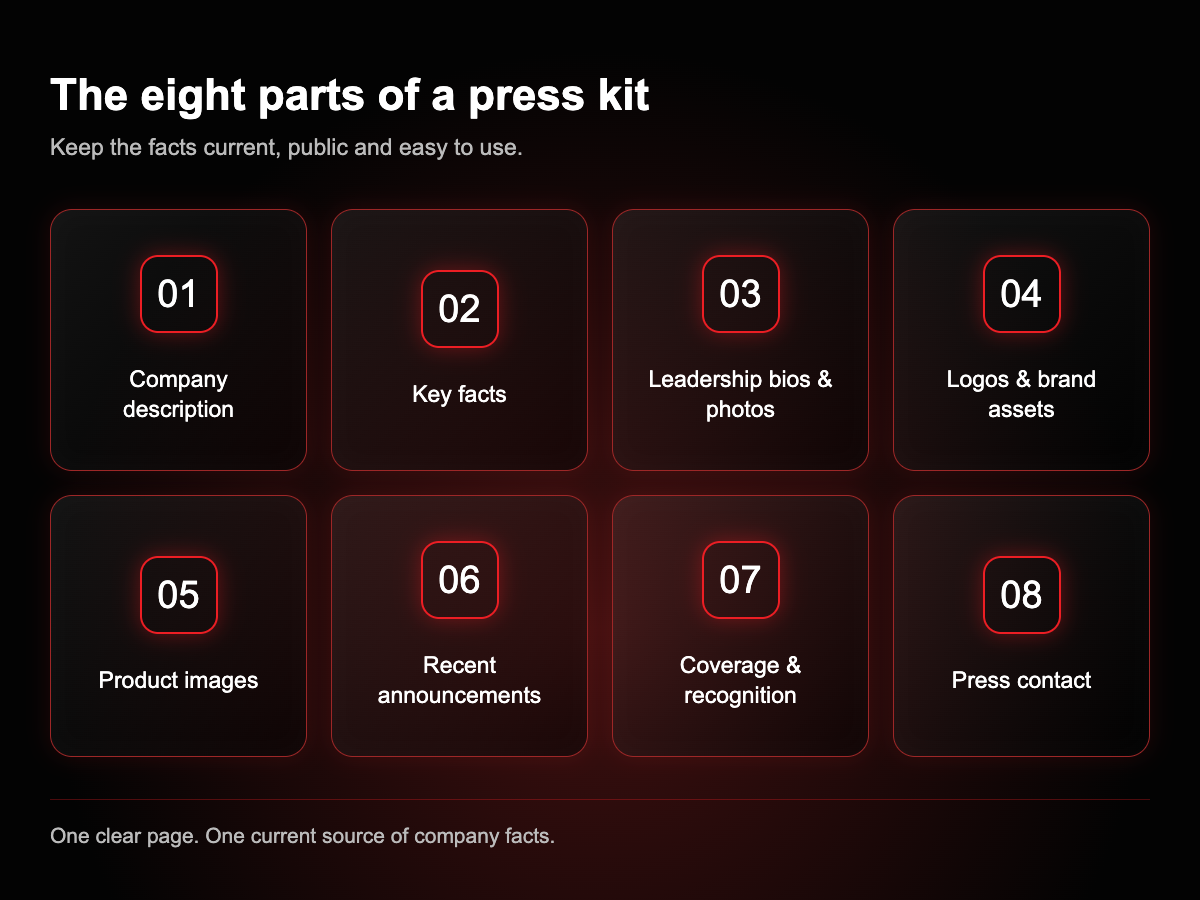
Most press kits that get used share the same eight parts. Each one answers a question someone would otherwise email you about.
| What to include | What it contains | Why it gets used |
|---|---|---|
| 1. Company description | A boilerplate of 50 to 100 words: what you do, for whom, founding year, headquarters | Copied word for word into articles, event pages and directories |
| 2. Key facts | Founding date, offices, markets, licenses or registrations, funding stage, any figures you already publish | Saves the fact-checking email and keeps numbers consistent |
| 3. Leadership bios and photos | A short and a long bio for each executive, current high-resolution headshots with a photo credit | Used in profiles, interviews and speaker pages |
| 4. Logos and brand assets | Logo files for light and dark backgrounds (SVG and PNG), brand colors, simple usage notes | Prevents stretched or outdated logos in coverage |
| 5. Product images and screenshots | Current product photos or interface screenshots, each with a caption | Lets a story show the product as it is today |
| 6. Recent announcements | Your latest releases, newest first, each dated and on its own page | Shows what changed and when, in your own words |
| 7. Coverage and recognition | Selected articles, interviews and awards, each linked to the source | Third-party proof in one place |
| 8. Press contact | One named person, a direct email, a phone number and the hours you answer | The step that turns a journalist’s interest into a story |
Leave out anything you would not want quoted. A press kit is public by design, so internal targets, unpublished numbers and draft messaging stay off it.
Digital press kit: a page on your site, not a PDF
A PDF press kit goes out of date the day after it is sent, and the old copy keeps circulating. A page on your site is updated once and is current for everyone who opens it.
A page also does three things a PDF does poorly:
- It can be found. Search engines index it, so it can appear when people search your company name.
- It can be read by machines. AI assistants and their crawlers usually read plain text on a page more easily than text inside a downloaded file.
- It can be linked. Every release, bio and profile can point to one stable address that never changes.
Keep the facts as text on the page and the files as downloads from it. A logo sheet can be an image. A company description inside an image cannot be copied by a person or read by an assistant. Show the date of the last update near the top, and do not put the page behind a form or a login.
Press kit vs media kit
The two names sound alike and point in opposite directions. A press kit is what a company gives to people who cover it: facts, people, assets and news. A media kit is what a publisher gives to advertisers: audience size and profile, ad formats, specifications and rates.
Some companies call their press page a media kit, and that is fine as long as the content is right. If you sell advertising or sponsorships yourself, keep the two on separate pages so each reader finds what they came for.
How a press kit feeds AI answers
Company-owned press pages are among the sources AI assistants cite most. A study by BuzzStream with citation data from Citation Labs looked at about 4 million AI citations and found that press releases and newsroom pages on company-owned domains made up 18% of ChatGPT’s citations, and about 3% on Google’s AI platforms. Syndicated copies of press releases were 0.04% of the full dataset (Search Engine Journal on the BuzzStream study).
A separate Proofsource study of 18,858 AI answers in October 2026 points the same way: companies’ own newsroom and press pages were cited 347 times, against 57 citations for wire copies about the same companies (Proofsource).
The practical reading: when an assistant describes your company, the page it is most likely to quote is your own press page, provided it exists, can be crawled and states the facts plainly. If the page is missing or out of date, the assistant fills the gap from whatever else it finds.
The same facts should match everywhere else your company appears: profiles, directories, partner pages and the coverage itself. A press kit that matches those sources is one of the results you want on what page one shows for your company name.
Keeping it current: what to update after every announcement
An outdated press kit does more harm than a missing one, because people and assistants trust it. After every announcement, run through the same short list:
- Add the new release with its date, at the top of the announcements list.
- Update any fact the news changed: markets, offices, licenses, leadership, funding stage.
- Replace bios and headshots when a role changes, and remove people who have left.
- Check that the company description still says what you do today.
- Confirm the press contact still answers, and update the “last updated” date.
For a launch, a funding round or entry into a new market, the release, the press kit and the coverage are best planned together. That is the work of digital PR with guaranteed press coverage: the announcement goes out, the facts are ready on your site, and the story appears on named publications your buyers read. What each stage costs is set out in our guide to press release distribution cost.
Tell us what you want to achieve
Share a few details about your goals and current challenges. Our team will review them and get back to you with the most useful next step.
Start a conversation.
Common press kit mistakes
- A PDF only. It cannot be updated in place and is hard for search engines and assistants to read.
- Facts inside images. A description or a list of figures that exists only as a picture cannot be copied or quoted.
- Old leadership. A former executive still listed is the error that travels furthest.
- No real contact. A general inbox with no name and no response time ends most requests.
- A description that differs from your profiles. Two versions of the same facts make both look less reliable.
- A form in front of the page. Anything behind a form or a login is invisible to crawlers.
- No dates. Announcements without dates leave readers guessing what is current.
Press kit: FAQ
What is a press kit?
A press kit is a page or folder with the facts and files anyone covering a company needs: a short description, key facts, leadership bios and photos, logos, product images, recent announcements and a press contact. Today it usually lives on the company website, where editors, partners and AI assistants can all read the same current version.
What should be included in a press kit?
Eight things: a company description of 50 to 100 words, key facts, leadership bios with current headshots, logo files for light and dark backgrounds, product images or screenshots, recent announcements with dates, selected coverage and awards with links, and one named press contact with a direct email and phone number.
What is the difference between a press kit and a media kit?
A press kit is what a company gives to people who write about it: facts, people, assets and news. A media kit is what a publisher gives to advertisers: audience figures, ad formats and rates. Some companies use the two names loosely. What matters is that the page holds what its reader came for.
Does a small business need a press kit?
Yes, and a simple one is enough: a short description, a few key facts, a photo and bio of the founder, a logo, any announcements and a contact. It takes an afternoon to build. It means that anyone who mentions the business, from a local paper to an AI assistant, has the right facts to work from.
Should a press kit be a PDF or a web page?
A web page. It can be updated once for everyone, it can be indexed by search engines and read by AI assistants, and every release and profile can link to it. Offer the logos, photos and a printable summary as downloads from the page, but keep the facts themselves as text.
How often should a press kit be updated?
After every announcement, and at least once a quarter even when nothing is announced. Check the facts, the leadership list, the headshots, the company description and the press contact, and update the date shown on the page. An outdated press kit spreads old facts faster than a missing one.