Why Buyers Trust Strangers More Than Your Brand
Every company wants to control its own story. It’s a fair instinct, and an expensive one. Look at where the money goes – websites, landing pages, sales decks, paid campaigns, case studies, that carefully worded About Us page. Every piece of it exists to answer three questions: who you are, what you do, and why anyone should pick you.
All of that is necessary. None of it is enough on its own.
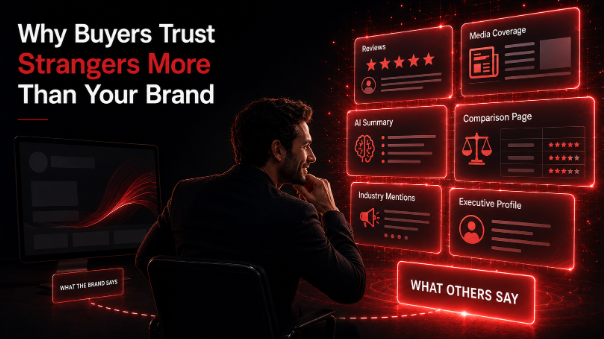
The closer a customer gets to a decision, the less they rely solely on what a company says about itself. They start looking elsewhere: searching the brand name, reading reviews, scanning industry articles, comparison pages, forums, social feeds, executive profiles, directories, media mentions. This isn’t distrust. It’s the simple recognition that a claim and a proof point are two different things. A website can make the claim; everything around it decides whether the claim gets believed. That’s the trust gap every brand has to work with.

Your Website Starts the Conversation. It Doesn’t Close It.
A strong website is still one of the most valuable assets a business has. It sets the positioning, frames the offer, and points people toward the next step. But it’s also the most controlled room in the building, and buyers know it. Of course it’s polished. Of course the claims are confident. It’s the brand on its best behaviour, which is exactly why, when the decision actually matters, people click away before they buy.
In high-trust sectors – financial services, fintech, PSPs, trading, iGaming – that step matters even more. By now the prospect is past “do I understand the offer.” The real questions are quieter and harder to answer. Is this company actually credible? Do other people say the same things it says about itself? Is there anything here I’ll end up regretting? A website can’t settle any of that. The answer lives in the wider environment around the brand.
Trust Lives Where the Brand Has the Least Control
The most persuasive trust signals tend to sit outside the company’s own domain. A review counts because a customer wrote it, not the brand. Coverage counts because a publication decided the story was worth running. Industry pieces put the company in context; an executive’s byline shows there’s real expertise behind the logo; directories and comparison pages confirm it actually exists and operates. None of it is clean – reviews can be unfair, articles date badly, forums are a mess, comparison pages often have a commercial axe to grind. But nobody’s hunting for one perfect source anyway. They’re reading for a pattern.
When a company’s own claims line up with what the rest of the internet says, trust goes up. When they don’t – when the outside picture is thin, contradictory or just missing – it drops, however good the website is. This is the gap brands routinely underestimate: they treat it as a messaging problem when it’s really a validation problem.
It’s also why third-party content has stopped being a footnote in the customer journey and become the place the decision often gets made. Someone might first meet the brand through an ad, a referral, an event or a LinkedIn post, but before they commit, they want confirmation from somewhere the brand doesn’t own. Does the company exist beyond its own marketing? Have real customers weighed in? Is the leadership visible? Have credible publications mentioned it, and does the story hold together across all of it? A broker can’t answer those with ad creative. A PSP can’t answer them with a slick product page. A fintech can’t answer them by insisting it’s secure. The market wants evidence – and supplying it is exactly what Digital PR, Online Reputation Management, SEO, review strategy and authority building are for. Different tactics, one job: making the brand easier to trust once the customer looks past the website.
The Danger of a Single Point of Trust

There’s a related mistake businesses make: leaning too hard on one platform to carry the entire reputation. For some it’s Trustpilot, for others Google Reviews, G2, Clutch, app-store ratings, a busy forum, or the single media result that dominates the brand’s search page. The platform isn’t the problem. The dependency is.
When most of a brand’s reputation lives in one place, it’s hostage to decisions it doesn’t make. The platform tweaks its policy. A bad review sticks around while a good one quietly disappears. A warning label shows up overnight. A competitor gets loud, the rankings shuffle, and an AI tool reads the entire company off one thin slice of sources. None of this requires the business to have done anything wrong. The service can be excellent and the customers happy, and the brand is still exposed, because all the proof is stacked in one spot. Spreading it out is the fix: reviews on the platforms that count, real third-party coverage, a healthier search page, executives who are actually visible. Risk doesn’t vanish, but one review page or one stale article no longer gets to define you.
AI Just Added Another Verifier
Here’s the newer wrinkle. Customers used to do the pattern-matching themselves: searching, opening tabs, weighing sources, forming a view over time. Now AI assistants do part of it for them, answering questions about a company’s credibility, risks and alternatives by drawing on the exact signals buyers were already checking by hand, from reviews and articles to profiles, media mentions and branded search.
For a brand, that means the same footprint that convinces a human now also feeds the machine that’s summarising you to that human. It doesn’t change what earns trust. It just raises the cost of getting it wrong. (Shaping how AI actually describes you is its own discipline; we get into the mechanics in Why Digital PR Now Decides What AI Says About You.)
A Strong Reputation Reduces Friction Before Sales
A good reputation does more than shield a company from bad results. It makes selling easier. When prospects research a brand and find a consistent, credible external footprint, they show up to the conversation already believing the company is legitimate. The sales team spends less time overcoming doubt and explaining credibility, and more time actually selling. That matters when a competitor is one search away. Put two similar companies side by side, and the one with stronger validation, better reviews, clearer executive presence and a healthier branded search environment wins ground before anyone picks up the phone.
This isn’t branding in the abstract. It shows up in conversion, in close rates, and in how hard the team has to lean on discounts, bonuses and aggressive follow-ups to get a deal over the line. When the reputation is already doing its job, a lot of that pressure simply isn’t there.
Start by Seeing What Your Buyers See
The practical first move isn’t to publish more. It’s to look at what a prospect actually finds when they check you out, across Google, AI assistants, review sites, industry publications and comparison pages, and ask whether that picture would make you trust the company. Is the story consistent? Is it carried by one fragile platform or spread across many? Do the confident claims on your site have any outside backing? Wherever that picture is thin, inconsistent or dominated by a single bad source, you’ve found the gap that’s quietly costing you deals. Closing it deliberately, rather than chasing every mention you can get, is the actual work.
Final Thoughts
Customers don’t distrust brands by default. But they do verify you, and there are more ways to do it than ever – search results, reviews, media coverage, Digital PR, an executive’s LinkedIn, an AI summary. All of it shapes an opinion before anyone fills out a form or books a call.
So third-party visibility can’t stay a secondary marketing activity. It’s the proof layer holding up the entire customer journey. The brands that get this won’t rely on their own website to build trust; they’ll build a wider, more resilient reputation across the places customers already look. Because what a company says about itself still counts. It’s just that what everyone else says about it usually counts for more.