
How to Measure Your Brand’s AI Share of Voice Against Competitors
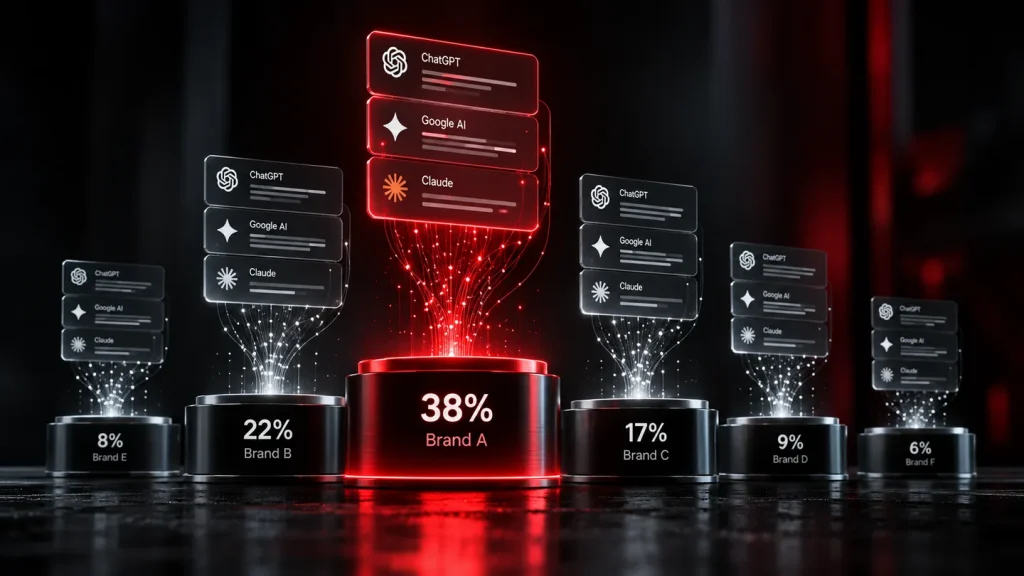
AI share of voice is your brand’s share of all the brand mentions AI assistants make when buyers ask about your category. Run a fixed set of buyer questions in ChatGPT, Gemini, Copilot, Perplexity and Google’s AI answers, count each brand’s mentions, divide yours by the total, then weight the result by position, sentiment and accuracy.
This guide gives the full method, from choosing the prompts to the weighted figure worth reporting to a board, and shows where a raw count misleads.
What Is Share of Voice in AI Search? AI Share of Voice vs Classic Share of Voice
Classic share of voice counts a brand’s share of ad impressions, search visibility or media mentions in its category. AI share of voice, often shortened to AI SOV, counts the brand’s share of the brand mentions inside AI answers.
The difference matters because an AI answer is short. A results page shows ten links. An answer names a few brands, often ranks them and says why. Being named, being named first and being named favorably are separate outcomes, and one percentage hides which one you got. There are four ways to express the number:
| Metric | What it counts | How it is calculated | What it misses |
|---|---|---|---|
| Mention share of voice | Answers that name your brand | Your mentions divided by all tracked brands’ mentions | Whether the mention helped or hurt, and where it sat in the answer |
| Position-weighted share of voice | Where the brand appears in each answer | Mentions scored by position (first counts more than fifth), your score divided by the total | Tone and accuracy: a brand named first as the cautionary example still scores high |
| Sentiment-adjusted share of voice | How the answer describes the brand | Mentions scored by position and tone, a warning counting against you, your net score divided by the total | Why the answer says it: the sources behind it |
| Citation share | The sources the answers cite | Citations of your domains divided by all citations in the tracked answers | Mentions without a citation |
Share of model and LLM share of voice: the same idea under other names
Share of model and LLM share of voice are names some marketers use for the same measure: the share of a language model’s answers that name a brand, set against the other brands in its category. Share of model borrows from the older idea of share of market. LLM share of voice simply names the technology.
The method below applies under every name. When two reports disagree, compare their prompt sets, engines and weighting before comparing the percentages.
How to Measure Share of Voice in AI Search, Step by Step
If the question on your desk is how to measure your brand’s share of voice in AI search, the work comes down to six steps. Repeated the same way every month, they give you an AI search share of voice figure you can defend in a meeting.
- Choose the competitor set. Four to six brands buyers actually compare you with, from lost deals and sales calls. Keep the set fixed between reads.
- Build 30 to 60 prompts from real buyer questions, in four groups: category (“best payment app for freelancers”), comparison (“[your brand] or [competitor]”), problem (“how do I stop failed card payments on subscriptions”) and trust (“is [your brand] legitimate”). Take the wording from sales calls, support tickets and Search Console.
- Run each prompt in each engine, more than once. Cover ChatGPT, Gemini, Copilot, Perplexity and Google’s AI Overviews and AI Mode, in a clean session per prompt, with search on where the engine offers it. Run every prompt at least three times, because answers vary from run to run.
- Set the counting rules first. One mention per brand per answer. Aliases, product names and misspellings map to the parent brand. Warnings are flagged, not dropped.
- Apply the formula. Your mentions divided by all tracked brands’ mentions, per engine and overall. An overall number can hide a brand that leads in one engine and is missing from another.
- Record the cited sources for every answer: each linked domain and page. This is the raw material for citation share.
Worked example: a payments app against three competitors
The figures in this example are invented to show the arithmetic. A payments app for freelancers tracks itself against three competitors with 40 prompts in four engines, three runs each: 480 answers holding 1,200 brand mentions. The app is named in 300 of them, a raw share of 25%. Competitor A is named 360 times, 30%.
Now score the mentions with the scale in the next section. Of the app’s 300, 60 put it first, 120 list it among others, 70 add a caveat and 50 name it as a warning, mostly in trust prompts that recall an old dispute about frozen payouts. The app scores 128 points out of 640 for all four brands: 20%. Competitor A, named first more often and rarely with a caveat, scores 243: 38%.
Raw, the app trails the leader by five points. Weighted, by eighteen: the gap buyers actually read.
Weight It: Position, Sentiment and Accuracy
A raw count treats every mention as good news. It flatters a brand that answers hold up as the cautionary example, quote with old pricing or confuse with a closed service. Each of those mentions adds to the raw share while it works against the brand with the buyer who reads it. Score every mention on two marks.
Position and tone
One workable scale:
- Named first, as the main recommendation: 1 point.
- Named in a list with other brands: 0.6 points.
- Named with a caveat (“solid, but the fees are high”): 0.3 points.
- Named as a warning or a bad example: minus 0.5 points.
Add up each brand’s points and divide yours by the sum for all tracked brands: that is the sentiment-adjusted share of voice. Keep the weights fixed, or earlier reads stop being comparable.
Accuracy
Mark each mention as correct, outdated or wrong. Outdated covers old pricing, retired products, former executives and past incidents told as current. Wrong covers facts that were never true, such as a competitor’s fee attributed to you. Report the accuracy rate beside the share. In the example, 45 of the app’s 300 mentions quote a withdrawal fee the app dropped: every buyer who reads it gets a wrong reason to choose a competitor.
Why the adjusted number is the one to report
The sentiment-adjusted figure answers what a board actually asks: does the answer move buyers toward us or away from us? A rising raw share with a falling adjusted share means the brand is discussed more and recommended less, which a plain mention count would report as progress.
Tone in AI answers follows the tone of the sources the engines read, which is why how sentiment shapes AI recommendations belongs in the same conversation as the count. When the accuracy mark shows outdated or wrong facts, the fix sits at those sources. Correcting what AI answers get wrong about a brand is reputation work, and measurement alone does not do it.
Citation Share: The Sources Behind the Answers
When an engine searches the web to answer, it shows where the answer came from. OpenAI, Google, Microsoft and Perplexity all document citations or source links on answers that use the web. Those links explain, better than anything else, why a brand was named.
For each category prompt, sort the cited domains into three groups: your own (site, help center, documentation), independent sources that name you, and independent sources that name only competitors. Citation share is your domains’ share of all citations. Study the third group closely: those pages teach the engines your competitors’ story.
Citation share tends to move before mention share. Answers that search the web are built from the pages they retrieve, so a page that now includes you can show among the sources before the wording shifts.
It also ties this metric to classic search, since the pages the engines cite are often pages that already rank. That is the reason to measure search and AI visibility together instead of running two separate programs.
What Is a Good AI Share of Voice?
There is no universal good percentage, and a benchmark quoted without its competitor set and prompt set tells you little. Read your number three ways.
- Against the competitor set. Who leads, and by how much. Twenty percent among six brands is a different position from 20% among three.
- Against your own earlier reads. The direction across several months says more than any single figure.
- Against your market share. A brand whose AI share of voice sits below its share of the market is under-represented in the answers its buyers read.
What does 50% share of voice mean?
Half of all brand mentions in the tracked answers name you. In a five-brand set that is dominance: you are named as often as the other four together. In a two-brand set it is parity.
For share of voice benchmarking in AI search, compare your sentiment-adjusted share with each competitor’s, per engine, over time. In a marketing metrics report that becomes one adjusted figure, its trend, the gap to the leader and the accuracy rate.
Tracking AI Share of Voice Over Time and by Engine
A monthly read suits most brands. Move to weekly during a launch, a pricing change or a crisis, when you need to see whether the change has reached the answers.
Report per engine. ChatGPT, Gemini, Copilot, Perplexity and Google’s AI features draw on different sources and can rank the same brands differently. For Google’s side, see how to track your brand in Google AI Overviews. For ChatGPT, the guide to share of voice in ChatGPT covers search mode, sessions and sources in that engine.
Treat a change as real only when it shows across the full prompt set over two consecutive reads. One answer that names you first, or leaves you out, is noise.
Measuring It Yourself or With a Tool: What a Tool Should Do
A spreadsheet is enough to start. Past a few dozen prompts in five engines, software becomes worth considering. An AI share of voice tool should:
- Run fixed prompt sets that you write and version.
- Cover several engines and report each separately.
- Repeat each prompt, with the number of runs visible.
- Record whether search was on for every answer.
- Use your competitor set, with aliases mapped.
- Mark sentiment and accuracy per mention, open to human review.
- Store the cited sources of every answer.
- Keep history and export raw answers.
- Cover the markets and languages you sell in.
Whatever the software, the judgment stays with your team: which prompts reflect real buyers, which competitors matter, and what to change once the number is in.
How to Raise AI Share of Voice
Three moves raise the number, best taken in this order.
1. Be present in the sources the answers cite
Go back to the third group of your citation read: comparison pages, industry reviews, trade and analyst pages and the sector’s review platforms that name competitors and leave you out. A fair, accurate place on those pages is the core of generative engine optimization, and it is usually the move that shifts citation share first.
2. Make your own facts unambiguous
State what the brand does, who it is for, how it charges and who leads it, in the same words on your site, profiles and documentation. Consistent facts let the engines match mentions to the right brand instead of a similarly named product or an older version of your company.
3. Correct what is wrong at the sources
When the accuracy mark shows outdated or wrong facts, the correction belongs at the pages the engines read: your own first, then the third-party pages carrying the old version. That is the work of AI reputation management. It corrects the facts at the source, and the answers follow the sources.
If you would rather see your own number first, the AI visibility report measures your brand’s share of voice across the main AI engines, with the sentiment of each mention and the sources behind it.
Want to know your brand’s share of voice in AI answers, and whether those mentions help or hurt? Request the AI visibility report, or talk to us if the answers already get you wrong.
AI Share of Voice FAQ
What is AI share of voice and how is it measured?
AI share of voice is your brand’s share of the brand mentions in AI answers about your category. Run 30 to 60 buyer questions in ChatGPT, Gemini, Copilot, Perplexity and Google’s AI features, three times each, count one mention per brand per answer, and divide your mentions by the total. Then weight each mention by position, sentiment and accuracy.
What is share of voice in AI search?
Share of voice in AI search is how often AI assistants name your brand, compared with competitors, when buyers ask about your category. Classic share of voice counts ads, rankings or press. The AI version counts mentions inside the answers, where a buyer may read three brand names and stop, so position and tone matter as much as the count.
How do I measure my brand’s share of voice in ChatGPT and Google AI Overviews?
Use one prompt set and four to six competitors in both. In ChatGPT, run each prompt in a clean session with search on, at least three times. In Google, record the AI Overview or AI Mode answer for each prompt, more than once. Count one mention per brand per answer, divide yours by the total and report each engine separately.
What is LLM share of voice?
LLM share of voice is another name for AI share of voice: the share of a large language model’s answers that name your brand, against the other brands in your category. It is measured with a fixed prompt set, repeated runs and one mention per brand per answer, and is most useful weighted by position, sentiment and accuracy.
What is a good share of voice percentage?
There is no universal good percentage. Judge the figure against your competitor set (who leads and by how much), against your earlier reads and against your market share. A brand whose AI share of voice sits below its market share is under-represented in the answers its buyers read. A rising sentiment-adjusted share matters more than any fixed target.
What is share of model?
Share of model is a name some marketers use for the share of an AI model’s answers that mention a brand, borrowed from the idea of share of market. It is the same measure as AI share of voice: a fixed set of buyer prompts, repeated runs, mentions counted per brand, and your mentions divided by the total.
How can I measure my share of voice in AI-generated search results?
Build 30 to 60 prompts from real buyer questions: category, comparison, problem and trust. Run each in every AI engine your buyers use, at least three times, in clean sessions with search on. Count one mention per brand per answer, flag warnings, divide your mentions by the total per engine, and record the cited sources.
What does 50% share of voice mean?
It means half of all brand mentions in the tracked AI answers name your brand. What that says depends on the number of brands tracked. In a five-brand set, 50% is dominance, because you are named as often as the other four together. In a two-brand set, it is parity.