Press Release Boilerplate: What It Is, What to Put in It, and a Template
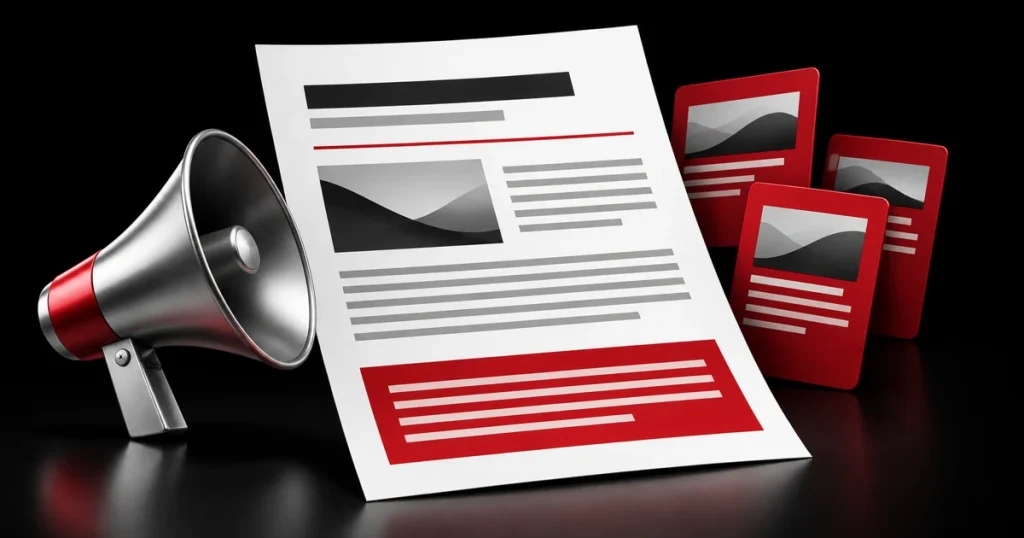
A press release boilerplate is the standard “About” paragraph at the end of a release: who the company is, what it does, for whom, where it is based and where to find more. It stays the same across releases, runs 50 to 100 words, and is often the part editors and AI assistants reuse when they describe the company.
Everything above the boilerplate changes with each announcement. The boilerplate does not. That is what makes it valuable: it is the one paragraph every editor, partner, customer and AI assistant sees in the same words, release after release, so it decides how your company is described when someone writes about you without calling first.
What a press release boilerplate is (and why it is called that)
The boilerplate sits at the very end of a press release, after the news and the quotes, usually under a heading such as “About [Company]”. It is a short, fixed description of the company that travels with every announcement.
The name comes from print. Newspapers used to receive ready-made text cast on metal plates, and “boilerplate” came to mean standard text that is reused without change. In a press release, that is exactly the job: a stable description that does not need rewriting each time.
A boilerplate is not the place for the news itself, for a sales pitch, or for a list of everything the company has ever done. It is a reference paragraph. Someone who reads only the boilerplate should come away knowing what the company is and why it is credible on the subject of the release.
What to put in a boilerplate: the six facts
A good boilerplate answers six questions in plain words:
- Who you are. The company’s legal or trading name, exactly as you want it written.
- What you do. One sentence on the category and the problem you solve, in the words your buyers use.
- Who you serve. The markets, customer types or industries you work in.
- Where you are. Headquarters city and country, and the main regions you operate in.
- Since when. The founding year, if it adds credibility.
- Where to find more. The website, and the newsroom or press page if you have one.
Two optional additions belong in it when they are true and verifiable: a license or regulator for a regulated business, and a fact that sets the company apart, stated as a fact rather than a claim (“serves clients in 30 countries” works, “the leading provider” does not).
Leave out awards that cannot be checked, superlatives, product lists and internal jargon. They make the paragraph longer and less likely to be quoted.
How long a boilerplate should be
Aim for 50 to 100 words. That is long enough to cover the six facts and short enough that an editor can drop it into a story unchanged. Anything over 120 words starts to read like a brochure, and the most useful sentence gets lost.
If a company has more than one business line, keep one boilerplate for the company and add a second, shorter one only when a release is about a product or a subsidiary that has its own identity.
Boilerplate template, with a labeled example for a fictional company
Use this structure and fill it with your own facts:
About [Company name]
[Company name] is a [category] that helps [customer type] [solve which problem]. Founded in [year] and headquartered in [city, country], the company serves [markets or regions]. [One verifiable fact that sets it apart.] For more information, visit [website] and the newsroom at [newsroom URL].
Illustration (a fictional company, not a client):
About Northline Pay
Northline Pay is a payments platform that helps online subscription businesses collect recurring revenue across currencies. Founded in 2017 and headquartered in Dublin, Ireland, the company serves merchants in more than 20 countries across Europe and North America. Northline Pay is authorised as an electronic money institution by its national regulator. For more information, visit northlinepay.example and its newsroom at northlinepay.example/newsroom.
That is 66 words. Every sentence is a fact a reader or an assistant can check, and nothing in it will be out of date next month.
Boilerplate mistakes that cost you coverage
Writing it like an advert. “The world’s most innovative” and “trusted by thousands” give an editor nothing to use and give an AI assistant no fact to repeat. Replace every adjective with the fact behind it.
Letting it drift. When each release carries a slightly different boilerplate, different descriptions of the company end up on different sites. Readers and assistants then meet three versions of who you are. Keep one master version and paste it, do not retype it.
Leaving old facts in. A boilerplate that still names a product you retired, an office you closed or a former CEO keeps spreading that fact with every release and every syndicated copy.
Hiding what you do. “Solutions for modern businesses” could describe any company. The category and the customer should be clear in the first sentence.
Contradicting your own pages. The founding year, headquarters and category in the boilerplate should match your About page, your press kit and your profiles word for word.
Why the boilerplate matters for AI answers
When an AI assistant describes a company, it builds the description from what it can read about it: the company’s own pages, coverage on publications it trusts, profiles and directories. A release and its coverage are part of that record, and the boilerplate is the part that repeats on every one of them.
That repetition is useful. A consistent paragraph that states the category, the market and the location in the same words across the newsroom, the release and the follow-up coverage gives assistants one clear version to work from. An inconsistent one gives them several, and they may pick the wrong one.
This is also why the boilerplate matters beyond the first release. In a digital PR campaign, press release distribution is the first stage, followed by articles on named publications and wider coverage. The boilerplate is the one paragraph that carries through every stage, and it is often what a writer uses when they need a short description of you. For how releases contribute to search and AI answers more broadly, see our guide to the SEO press release.
When to update it
Review the boilerplate whenever a fact in it changes: a new market, a new headquarters, a license, a change in what the company does, or a new name. Otherwise, read it once a quarter against the About page and the press kit, which should carry the same paragraph.
When you update it, update it everywhere at once: the newsroom, the press kit, the next release and the profiles that quote it. A new boilerplate on one release and the old one on the website is the drift problem again.
Planning an announcement? We run digital PR campaigns with guaranteed coverage, from the release to the follow-up articles.
Tell us what you want to achieve
Share a few details about your goals and current challenges. Our team will review them and get back to you with the most useful next step.
Start a conversation.
Press release boilerplate: FAQ
What is a boilerplate in a press release?
A boilerplate is the short, standard paragraph at the end of a press release that describes the company: what it does, for whom, where it is based and where to find more. It stays the same across releases, so readers and AI assistants meet one consistent description of the company every time.
Where does the boilerplate go in a press release?
The boilerplate goes at the end of the release, after the news, the quotes and any supporting details, and before the media contact. It usually sits under a heading such as “About [Company]”. If a release involves two companies, each gets its own boilerplate, one after the other.
How long should a press release boilerplate be?
Aim for 50 to 100 words. That covers the company name, what it does, who it serves, where it is based, when it was founded and where to find more. Past about 120 words it reads like a brochure, and editors are less likely to use it as written.
Should every press release use the same boilerplate?
Yes. Use one master version and paste it into every release, changing it only when a fact changes. Different versions on different releases create different descriptions of the company across the web, which confuses readers and the AI assistants that build answers from those pages.
What is the difference between a boilerplate and a company description?
A boilerplate is a short company description written for one job: to sit at the end of a press release and be reusable as it is. A company description on an About page can be longer and tell more of the story. The facts in both should match.
Do AI assistants read the press release boilerplate?
AI assistants read the pages a release appears on, including the company’s own newsroom and the coverage that follows, and the boilerplate is part of that text. Because it repeats on every page in the same words, a clear, factual boilerplate helps assistants describe the company consistently and correctly.